
Book Description
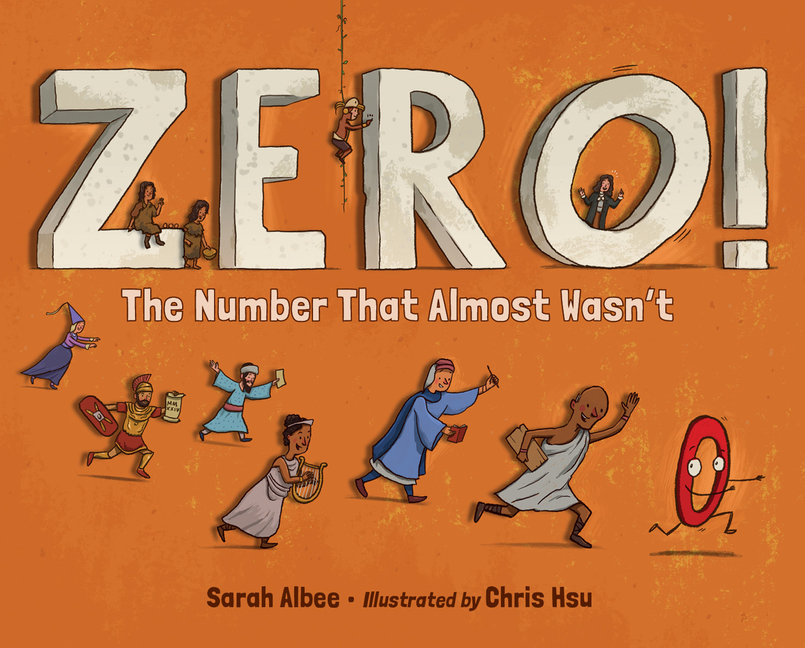
for Zero! by Sarah Albee and Chris Hsu
From Cooperative Children's Book Center (CCBC)
Zero, “a number that means nothing,” has great meaning in the world of mathematics, but as a numeral, zero “had to be invented.” This informational text takes the reader on a crash course through the history of zero, beginning with early humans who counted with the help of objects and moving on to various civilizations’ mathematical developments. Babylonians, for instance, created place value, including a symbol to represent an empty value (as in the number 309). (The Maya people used a symbol for zero, too, but their records were mostly destroyed.) It was an unknown Indian mathematician who created the first zero that was introduced to others via trade routes; when the information reached Persia, a man named al-Khwarizmi wrote a book about the Indo-Arabic numerals that we know and use today. Interestingly, though perhaps not surprisingly, it took some time for Europe to embrace this number system, which they considered foreign and suspect. With the adoption of these numerals over time, though, mathematics flourished, and “new fields of knowledge opened up.” With occasional helpful diagrams to illustrate concepts, this book of math history is digestible and enlightening.
CCBC Choices 2026. © Cooperative Children's Book Center, Univ. of Wisconsin – Madison, 2026. Used with permission.
