
Book Description
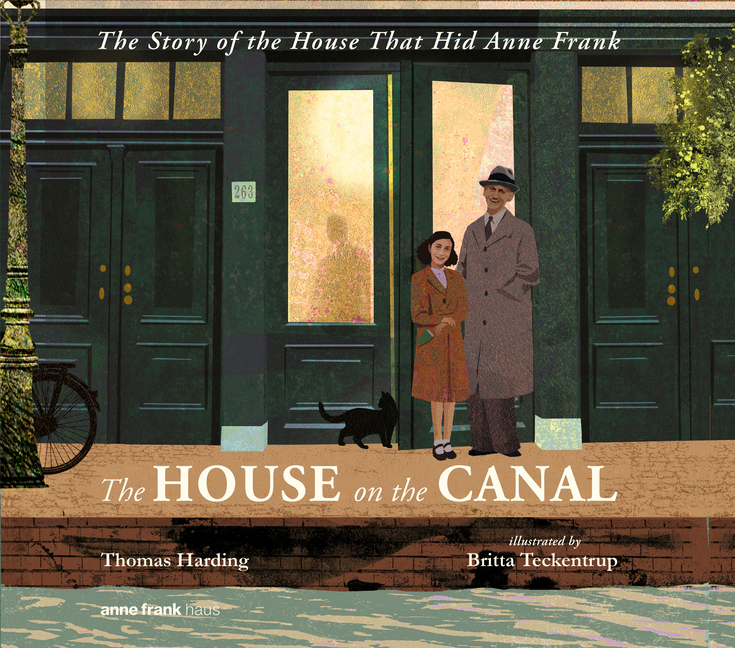
for The House on the Canal by Thomas Harding and Britta Teckentrup
From Cooperative Children's Book Center (CCBC)
Long before it became a hiding place for Anne Frank, the “tall, narrow house” on an Amsterdam canal served many different roles. Constructed in 1635, the brick house with a green front door housed a succession of families: the stonemason who built it; a young woman and her twelve children, who weathered a plague there; a wealthy merchant and his wife, who renovated it. It became a horse stable, and then a chemist’s workplace. It survived a fire. It was home to many more families over the years, families with children who played on the roof between the front house and annex, and who spent time under the chestnut tree in the garden. When World War II began, the house was empty. Otto Frank purchased it for his business in 1941. His diarist daughter, “a young girl with a sweet smile,” is the house’s most famous occupant. After the war, Anne’s father returned to the house alone. He shared his daughter’s diary with the world, and later he helped to turn the house into a museum visited by all kinds of people. Beautifully detailed, earth-toned illustrations perfectly complement this illuminating narrative about a house with a rich and tragic history.
CCBC Choices 2026. © Cooperative Children's Book Center, Univ. of Wisconsin – Madison, 2026. Used with permission.
