
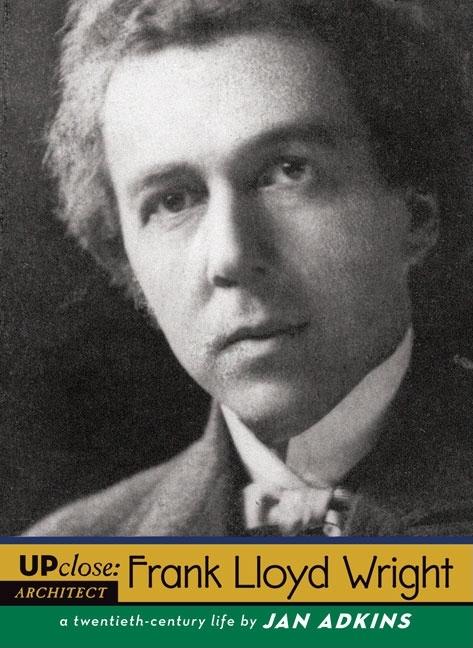
Book Descriptions
for Frank Lloyd Wright by Jan Adkins
From Cooperative Children's Book Center (CCBC)
This exciting and eloquent biography offers a refreshing examination of the life of Frank Lloyd Wright, legendary architect. The introduction of the book reads like an introduction to the man himself—Adkins’ vivid descriptions and helpful historical contexts make it seem as though we are meeting Mr. Wright at one of his infamous parties rather than through the pages of a book. A captivating character, the author shows Frank Lloyd Wright as a phenomenon whose work impacted the way we interact with buildings and spaces. The word rogue is introduced to show additional dimensions of Frank Lloyd Wright’s influence. As one kind of rogue, Wright was liar and scoundrel who manipulated facts and figures his whole life through. Rogue can also mean beggar , and Wright was constantly in debt, both personally and professionally, despite his success. Wright was a mesmerizing and talented person—a master trickster who got exactly what he wanted—yet another definition of rogue. An architect of words, Adkins offers a highly engaging look at one of America’s most notable, and controversial, figures. (Age 12 and older)
CCBC Choices 2008. © Cooperative Children's Book Center, Univ. of Wisconsin - Madison, 2008. Used with permission.
From the Publisher
Discover the incredible life and enduring legacy of Frank Lloyd Wright in this captivating Up Close biography series about twentieth-century America.
“Entertaining and educational.”—School Library Journal
Genius, poseur, egomaniac, innovator, sly rascal—in the ninety-three years of his stormy life, Frank Lloyd Wright was all of these. He was a ladies’ man, a clotheshorse, a deadbeat, and, with three months of formal training, the greatest architect of the twentieth century. Wright was an enigma with a colossal vision, an innate ability to think in three dimensions, an instinctive sense of engineering, and a furious disdain for the classical style that dominated American architecture.
Wright changed the way we live. As a one-man force for a uniquely American style, he swept away dark, Victorian clutter and opened up living spaces to air and movement. His professional life was a torrent of invention, from his earliest homes of the late 1800s to the bold spiral of the Guggenheim Museum in 1959. More fascinating and colorful than his own designs, Frank Lloyd Wright was consistently controversial, a towering figure in our culture who deserves his status as an American icon.
This is one of the titles in Up Close, a riveting, all-access biography series that celebrates the leaders, artists, and legends of twentieth-century America—and the impact they had on the world.
“Entertaining and educational.”—School Library Journal
Genius, poseur, egomaniac, innovator, sly rascal—in the ninety-three years of his stormy life, Frank Lloyd Wright was all of these. He was a ladies’ man, a clotheshorse, a deadbeat, and, with three months of formal training, the greatest architect of the twentieth century. Wright was an enigma with a colossal vision, an innate ability to think in three dimensions, an instinctive sense of engineering, and a furious disdain for the classical style that dominated American architecture.
Wright changed the way we live. As a one-man force for a uniquely American style, he swept away dark, Victorian clutter and opened up living spaces to air and movement. His professional life was a torrent of invention, from his earliest homes of the late 1800s to the bold spiral of the Guggenheim Museum in 1959. More fascinating and colorful than his own designs, Frank Lloyd Wright was consistently controversial, a towering figure in our culture who deserves his status as an American icon.
This is one of the titles in Up Close, a riveting, all-access biography series that celebrates the leaders, artists, and legends of twentieth-century America—and the impact they had on the world.
Publisher description retrieved from Google Books.

