

Book Resume
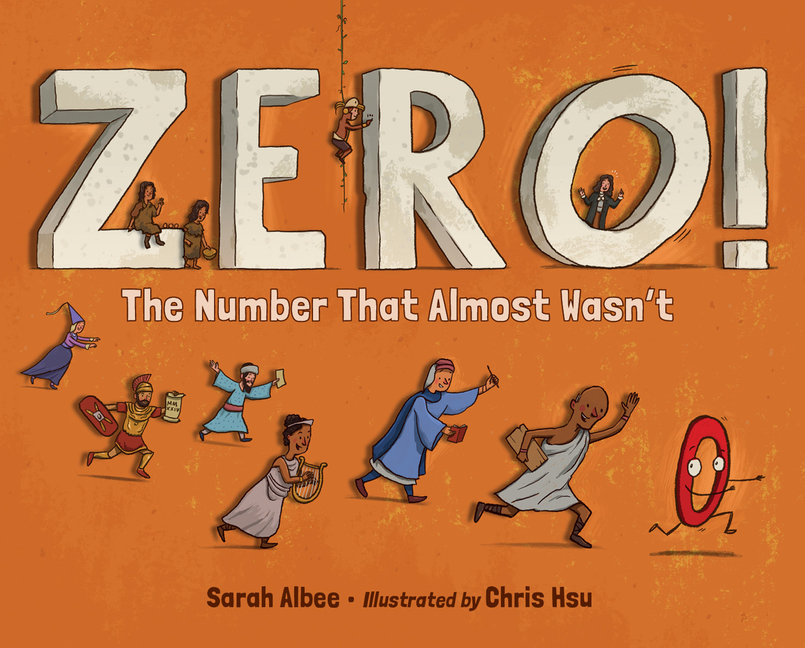
for Zero!: The Number That Almost Wasn't by Sarah Albee and Chris Hsu
Professional book information and credentials for Zero!.
- Kirkus:
- Ages 7 - 10
- School Library Journal:
- Grades 1 - 4
- Booklist:
- Grades 1 - 4
- TeachingBooks:*
- Grades 1-4
- Year Published:
- 2025
3 Subject Headings
The following 3 subject headings were determined by the U.S. Library of Congress and the Book Industry Study Group (BISAC) to reveal themes from the content of this book (Zero!).
5 Full Professional Reviews (3 Starred)
The following unabridged reviews are made available under license from their respective rights holders and publishers. Reviews may be used for educational purposes consistent with the fair use doctrine in your jurisdiction, and may not be reproduced or repurposed without permission from the rights holders.
Note: This section may include reviews for related titles (e.g., same author, series, or related edition).
From Kirkus
Starred review from June 1, 2025
This fun and fascinating story traces the lengthy path from "nothing" to a functioning zero. Albee begins with prehistory (since the concept of nothing long predated the idea of zero) and progresses to the Babylonians, ca. 300 B.C.E., while also noting the Mayans' independent invention of zero. She then credits the "unknown Indian mathematician" who first wrote zero as a numerical symbol (identified in the timeline as the Bakhshali manuscript), followed by Brahmagupta, who used zero in calculations. Many pages are devoted to the challenges of getting zero to be accepted in Europe, where it eventually enabled calculus and the scientific revolution. The backmatter notes that zero was crucial to computer coding. The book brilliantly traverses the history of zero across time and continents and clearly explains its initial value as a placeholder. Elegant and delightfully intricate illustrations superbly evoke history in clothes and settings. The composition of the spread depicting mathematician Fibonacci is, per the backmatter, "roughly organized [per] the Fibonacci sequence"--an especially clever detail. Numerous figures are brown-skinned; many are female. The art alone will grab many readers, who will readily stay to be enthralled by the numbers. An excellent historical and mathematical introduction to a key concept. (more information on zero, map, bibliography, further reading, timeline, notes about the art)(Informational picture book. 7-10)
COPYRIGHT(2025) Kirkus Reviews, ALL RIGHTS RESERVED.

From Horn Book
May 1, 2025
In a cheerful picture book populated by Hsu's inquisitive cartoon humans, Albee traces the history of the number zero. From the ancient Babylonians who invented place value four thousand years ago, to the Romans who developed a system of Vs, Is, and Xs; from the Mayans who had a concept of zero but no way to spread their idea to the rest of the world, to the Indian scribe who invented a symbol for zero and the Persian mathematician who popularized it, the invention of zero was a worldwide effort with triumphs and setbacks. Parts of Europe were perhaps the last to adopt the Hindu-Arabic number system, with Roman numerals persisting into the eighteenth century in some banking operations. (A timeline gives a "blurry" portrait of when various developments occurred.) The narrative treads lightly but doesn't gloss over ways in which Western xenophobia and religious fanaticism delayed zero's adoption. Meanwhile, the illustrations get into the spirit of archaeological inquiry with touches such as heritage breeds of dogs and sheep in the portrayal of historical communities and a nod to Halley's comet. Philosophical considerations ("why create a symbol to represent nothing?") and mention of the fields (e.g., physics, computing) that arose as a result of the Hindu-Arabic number system round out the presentation, while a few notes about definitions, a world map, and a bibliography complete the back matter. Place this book in the hands of a budding numerophile and watch them start to put two and two together. Anita L. Burkam
(Copyright 2025 by The Horn Book, Incorporated, Boston. All rights reserved.)

From School Library Journal
Starred review from April 4, 2025
Gr 1-4-Albee constructs a conversational, matter-of-fact narrative about the many years humans calculated on counting boards, used their fingers, put knots in strings and beads on lines, all for the lack of a-nothing. Until the Babylonians around 300 BCE, there was no such thing as a placeholder for single digits, tens, hundreds, and beyond. It's another 500-700 years before a mathematician in ancient India uses zero not only as a placeholder, but a number. Then comes adoption-not everyone is a fan of zero, including the Christians fighting a holy war against Muslims, suspicious of zero's Indian/Arabic associations. A brilliant unfolding and pacing of the narrative bring order to the near-misses and chaos of zero's origins, shored up by the various obstacles readers can discover in the time line. That calculus and algebra were also invented along the way feels nothing short of miraculous. Hsu's global scenes are cheerful and accessible, with pages that show people counting, adding, sorting, much as children do. It all adds up to an epic story of the little nothing that could, and did, launch or change engineering, modern physics, computing, and electronics forever. VERDICT Educators can build an entire lesson around zero, especially given the thoughtful resources and chatty time line provided in the back matter.-Kimberly Olson Fakih
Copyright 2025 School Library Journal, LLC Used with permission.

From Booklist
Starred review from February 1, 2025
Grades 1-4 *Starred Review* This cheerful picture book tells the story of how it took thousands of years for humans to realize that something was missing: a zero! It explains why it was so difficult to imagine something that actually meant nothing and documents how this emerging concept of nothingness fared in various civilizations around the world, taking several centuries to finally catch on. From the ancient Babylonians, the first to assign place values and realize that they needed a symbol showing nothing in this position, to Brahmagupta, a mathematician from India who wrote in Sanskrit to explain the significance of the numbers zero through nine, the plot follows the development of increasingly more complex math applications, from algebra (Persia) to calculating (Fibonacci) to calculus (Isaac Newton and Gottfried Wilhelm Leibniz). The book mentions initial European resistance, including how a few Christian leaders actually banished zero, until the invention of the printing press helped spread the concept and led to innovations in physics, engineering, electronics, and computers. Appealing digital drawings and rich back matter (uses of zero in everyday language, definitions, a time line, references, a bibliography, and a key to historical clues found in the illustrations) help round out this unique and attractive STEM offering.
COPYRIGHT(2025) Booklist, ALL RIGHTS RESERVED.

From Horn Book
January 1, 2025
In a cheerful picture book populated by Hsu's inquisitive cartoon humans, Albee traces the history of the number zero. From the ancient Babylonians who invented place value four thousand years ago, to the Romans who developed a system of Vs, Is, and Xs; from the Mayans who had a concept of zero but no way to spread their idea to the rest of the world, to the Indian scribe who invented a symbol for zero and the Persian mathematician who popularized it, the invention of zero was a worldwide effort with triumphs and setbacks. Parts of Europe were perhaps the last to adopt the Hindu-Arabic number system, with Roman numerals persisting into the eighteenth century in some banking operations. (A timeline gives a "blurry" portrait of when various developments occurred.) The narrative treads lightly but doesn't gloss over ways in which Western xenophobia and religious fanaticism delayed zero's adoption. Meanwhile, the illustrations get into the spirit of archaeological inquiry with touches such as heritage breeds of dogs and sheep in the portrayal of historical communities and a nod to Halley's comet. Philosophical considerations ("why create a symbol to represent nothing?") and mention of the fields (e.g., physics, computing) that arose as a result of the Hindu-Arabic number system round out the presentation, while a few notes about definitions, a world map, and a bibliography complete the back matter. Place this book in the hands of a budding numerophile and watch them start to put two and two together.
(Copyright 2025 by The Horn Book, Incorporated, Boston. All rights reserved.)
3 Book Awards & Distinctions
Zero! was recognized by committees of professional librarians and educators for the following book awards and distinctions.
 Best STEM Books, 2017-2026, Selection, 2026
 Junior Library Guild Selections, 2012-2025, Instructional Nonfiction Selection, 2025
 SLJ Best Books of the Year, 2010 - 2025, Selection, 2025
Preview Digital Book
Explore Zero! on Marketplace. Access requires OverDrive Marketplace login.
This Book Resume for Zero! is compiled from TeachingBooks, a library of professional resources about children's and young adult books. This page may be shared for educational purposes and must include copyright information. Reviews are made available under license from their respective rights holders and publishers.
*Grade levels are determined by certified librarians utilizing editorial reviews and additional materials. Relevant age ranges vary depending on the learner, the setting, and the intended purpose of a book.
Retrieved from TeachingBooks on December 25, 2025. © 2001-2025 TeachingBooks.net, LLC. All rights reserved by rights holders.
