

Book Resume
for Food for Thought by Melissa Iwai
Professional book information and credentials for Food for Thought.
5 Professional Reviews (2 Starred)
Selected for 1 State/Province List
- Kirkus:
- Ages 5 - 8
- School Library Journal:
- K - Grade 3
- Kirkus:
- Ages 5 - 8
- School Library Journal:
- Grades 1 - 3
- Booklist:
- K - Grade 2
- TeachingBooks:*
- Grades PK-2
- Word Count:
- 512
- ATOS Reading Level:
- 2
- Cultural Experience:
- Asian American
- Year Published:
- 2023
12 Subject Headings
The following 12 subject headings were determined by the U.S. Library of Congress and the Book Industry Study Group (BISAC) to reveal themes from the content of this book (Food for Thought).
- Natto?--Juvenile fiction
- Japanese Americans--Fiction
- Breakfasts--Juvenile fiction
- Breakfasts--Fiction
- Families--Juvenile fiction
- Family life--Fiction
- Natto?--Fiction
- JUVENILE FICTION / Diversity & Multicultural
- Japanese Americans
- Japanese Americans--Juvenile fiction
- Food--Fiction
- Food--Juvenile fiction
5 Full Professional Reviews (2 Starred)
The following unabridged reviews are made available under license from their respective rights holders and publishers. Reviews may be used for educational purposes consistent with the fair use doctrine in your jurisdiction, and may not be reproduced or repurposed without permission from the rights holders.
Note: This section may include reviews for related titles (e.g., same author, series, or related edition).
From Kirkus
July 15, 2023
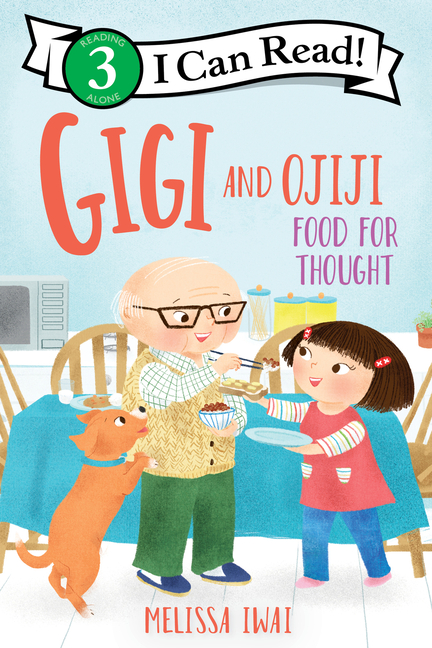
Gigi and Ojiji are back and trying new foods. One morning, Gigi, a biracial child whose mother is Japanese and whose father presents white, makes breakfast for her family. She prepares her favorite breakfast--peanut butter, berries, and bananas on toast--but Ojiji, her Japanese grandfather, doesn't eat it all. Mom says that Ojiji doesn't like peanut butter, so Gigi asks her to make something people from Japan eat. The following day, they have a traditional Japanese breakfast, which includes salmon, rice, and miso soup. Ojiji and Mom have an additional bowl, which contains natto, fermented soybeans; Gigi thinks that the natto is sticky and slimy and that it smells a bit odd. But when she takes a bite, she lies, saying it tastes good. When her mom includes natto again at dinner, Gigi attempts to hide her food, but Roscoe, her dog, exposes the truth. Highlighting a sweet intergenerational relationship, this is a wonderful addition to the early reader series. Iwai advises readers not to force themselves to like everything even if others love it--what's important is trying new things. The cartoon art highlights emotions and culture, adding context to help decipher vocabulary. A glossary contains the Japanese words used in the story but no pronunciation guide. Encouragement to try new things even if we end up disliking them. (Early reader. 5-8)
COPYRIGHT(2023) Kirkus Reviews, ALL RIGHTS RESERVED.
From School Library Journal
July 1, 2023
K-Gr 3-One morning, Gigi rises early to make her favorite peanut butter breakfast for her family. However, she is stunned when her Japanese grandpa, Ojiji, expresses gratitude but neglects to eat it. Her mother suggests that maybe Ojiji doesn't like peanut butter. Gigi is surprised: How can anyone dislike peanut butter? She wants to give Ojiji something he likes, so the next morning her mother makes a traditional Japanese breakfast of pickles, salmon, rice, miso soup, and natto (soybeans). But as Gigi takes a bite of natto, she realizes she doesn't like it. With kindness to her grandfather, Gigi is brave-she tries it again when her mother adds it to pancakes. But she still doesn't like it! In this endearing tale, Gigi learns firsthand that not everyone likes what she likes. Ojiji, originally from Japan, prefers traditional Japanese fare. Through both pictures and narrative, this story demonstrates empathy. The illustrations, presented in a muted primary color palette, show the warmth and love between family members as Gigi and Ojiji share the foods they love and the understanding that it's okay not to love everything. This early reader also presents acculturation themes, with Gigi enjoying the tastes of a traditional American childhood, but also learning the foods of her family's culture. Back matter includes an offering of Japanese vocabulary words. VERDICT A fine-tuned depiction of empathy and cultural identity development. Celebrating Japanese culture, this is a heartwarming family story for independent readers.-Jennifer Strattman
Copyright 2023 School Library Journal, LLC Used with permission.
From Kirkus
May 1, 2022
Can a young American girl navigate cultural and linguistic differences with her Japanese grandfather? Gigi, a girl with pale skin and short, dark brown hair, can't wait until Ojiisan (grandfather) comes to live with her family, which includes her Japanese mother, her White father, and Roscoe, their playful dog. But when the family meets Ojiisan at the airport, Gigi's hopes for instant connection are dashed in the face of language and culture barriers. Disappointed, Gigi tearfully confides in her mother, who helps to clear up the misunderstandings. Though Gigi is upset that her grandfather tucked away the drawing she made instead of opening it, Mom explains, "Most Japanese people his age think it's rude to open a present in front of the person who gave it to them." With support from Mom, Gigi reaches out again to Ojiisan and finds that they can teach each other the words and cultural norms they don't yet know. This book combines a large font, colorful cartoon art, and an age-appropriate plot in order to introduce the topic of cross-cultural differences (and the emotions that come with bridging them). Gigi experiences a wide range of feelings, which young ones can consider as they follow her story. A glossary contains a handful of Japanese words used in the story but does not include any hints at pronunciation. (This book was reviewed digitally.) An affirming option in the quickly diversifying field of early-reader books. (Early reader. 5-8)
COPYRIGHT(2022) Kirkus Reviews, ALL RIGHTS RESERVED.
From School Library Journal
Starred review from April 1, 2022
Gr 1-3-Gigi is excited to meet her grandpa, Ojiisan, who is arriving from Japan to live with her family. Even with her basic Japanese vocabulary and the drawing she made to welcome him, their introduction stumbles through several cross-cultural misunderstandings, which makes Gigi cry. Her mom helps her understand the differences between American and Japanese culture and reassures Gigi that all will be well in time. Gigi's interiority is well represented in this wonderful early reader; her thoughts and worries are front and center. Her need for adult consolation and the child-friendly explanations of cultural context will resonate with young readers. The arc of the story is easy to follow. Diversity is well represented; readers will see in the bright, adorable art that Gigi's dad is white, and her mom is Japanese. Readers will also have to make a few inferences about the story, but with three to seven sentences per page, the images support the text to help children understand Gigi's feelings, her parents' reassurances, Roscoe the dog's actions, and Ojiisan's mannerisms. Although some sentences are 10 to 18 words long and some pages contain up to nine six-letter words, most of the text is short dialogue. Japanese words are explained through conversation, and there is a glossary at the end to cement understanding. VERDICT Gigi crafts her Japanese American identity in this enchanting early reader. The cuteness, inclusivity, and cross-cultural problem-solving represented will have young readers coming back again and again. A must-buy.-Jamie Winchell
Copyright 2022 School Library Journal, LLC Used with permission.
From Booklist
Starred review from March 1, 2022
Grades K-2 *Starred Review* Gigi is so excited! Today, Ojiji (Grandpa) is coming from Japan to live with her family. She has so many ideas for them to do together--playing tag, reading books, and teaching her dog new tricks. But Gigi's plans are almost immediately scuttled when they pick Ojiji up from the airport. Not only does Ojiji need help adjusting to life in America, Gigi's afraid he doesn't like her! Gigi spills all her worries to her mother, who explains that some things are done differently in Japan. For instance, people often bow rather than hug. Feeling reassured, Gigi's excitement returns along with some new plans for her time with Ojiji. As a level 3 reader, this book for independent readers uses longer sentences and more complex vocabulary, but the text is well supported by the endearing illustrations, which capture all of Gigi's big emotions and depict her as a biracial child, with a white father and Japanese mother. A sweet rapport begins to develop between the girl and her grandfather by story's end, giving this tale of relatable worries a comforting end.
COPYRIGHT(2022) Booklist, ALL RIGHTS RESERVED.
1 Selection for State & Provincial Recommended Reading Lists
Food for Thought was selected by educational and library professionals to be included on the following state/provincial reading lists.
United States Lists (1)
Preview Digital Book
Explore Food for Thought on Marketplace. Access requires OverDrive Marketplace login.
This Book Resume for Food for Thought is compiled from TeachingBooks, a library of professional resources about children's and young adult books. This page may be shared for educational purposes and must include copyright information. Reviews are made available under license from their respective rights holders and publishers.
*Grade levels are determined by certified librarians utilizing editorial reviews and additional materials. Relevant age ranges vary depending on the learner, the setting, and the intended purpose of a book.
Retrieved from TeachingBooks on December 25, 2025. © 2001-2025 TeachingBooks.net, LLC. All rights reserved by rights holders.
