

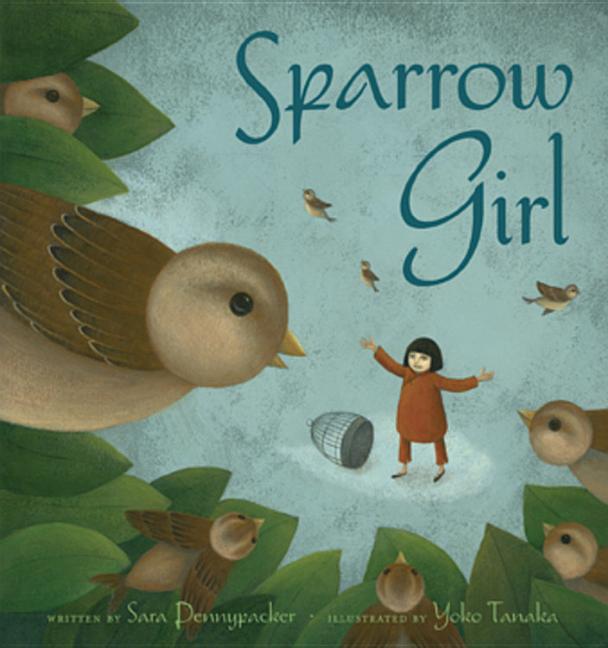
Book Resume
for Sparrow Girl by Sara Pennypacker and Yoko Tanaka
Professional book information and credentials for Sparrow Girl.
- School Library Journal:
- K - Grade 4
- Publisher's Weekly:
- Ages 5 - 9
- Booklist:
- K - Grade 3
- TeachingBooks:*
- Grades PK-6
- Word Count:
- 1,597
- Lexile Level:
- 590L
- ATOS Reading Level:
- 3.7
- Cultural Experience:
- Asian
- Genre:
- Historical Fiction
- Picture Book
- Year Published:
- 2009
16 Subject Headings
The following 16 subject headings were determined by the U.S. Library of Congress and the Book Industry Study Group (BISAC) to reveal themes from the content of this book (Sparrow Girl).
- 1949-1976
- China
- Food chains (Ecology)
- Sparrows
- Farm life--Juvenile fiction
- Food chains (Ecology)--Juvenile fiction
- China--History--1949-1976--Fiction
- History
- Children's Books/Ages 9-12 Fiction
- Juvenile Fiction | General
- China--History--1949-1976--Juvenile fiction
- Sparrows--Fiction
- Farm life
- Farm life--Fiction
- Food chains (Ecology)--Fiction
- Sparrows--Juvenile fiction
4 Full Professional Reviews
The following unabridged reviews are made available under license from their respective rights holders and publishers. Reviews may be used for educational purposes consistent with the fair use doctrine in your jurisdiction, and may not be reproduced or repurposed without permission from the rights holders.
Note: This section may include reviews for related titles (e.g., same author, series, or related edition).
From Horn Book
July 1, 2009
In 1958 China, battle is declared against sparrows--they're eating too much grain. Ming-Li defies the shortsighted directive of "Our Leader" by protecting the birds instead of shooing them from the village. Pennypacker creates a memorable heroine in Ming-Li, who, as a "small girl," is initially discredited. Tanaka is in command of each painterly illustration, some of which hint at the surreal.
(Copyright 2009 by The Horn Book, Incorporated, Boston. All rights reserved.)

From School Library Journal
March 1, 2009
K-Gr 4-In 1958, in a stunning demonstration of unintended consequences, Mao Tse-tung decimated the sparrow population of China by compelling every able-bodied citizen to set off firecrackers, clang gongs, beat on drums, etc., over a three-day period. The frightened birds took wing until they dropped dead of exhaustion. Though this kept the sparrows from eating the wheat crop, it also prevented them from controlling the locust population, resulting in a famine. Pennypacker has imagined the thoughts and actions of a little girl who loves the sparrows and manages to rescue a few of them, keeping them safe in a barn and feeding them secretly in the months that follow. When the crops in her village are threatened by the insects, Ming-Li shows the farmers the birds she has tended and they release them, recognizing that the sparrows have always been their friends. While this picture book, with its murky folk-art-style illustrations, owes more to ecological concerns than historical fact, it will be useful in teaching about the potential of one person to make a difference in the world, and the potential of many humans to create disasters."Miriam Lang Budin, Chappaqua Public Library, NY"
Copyright 2009 School Library Journal, LLC Used with permission.

From Publisher's Weekly
January 26, 2009
The so-called Sparrow War, declared by Mao in 1958, furnishes the basis for this grim story. Deciding that sparrows are eating too much grain, “our Leader” orders his people to drive them away, and Ming-Li’s whole village turns out to “ so much noise the ground itself rumble.” Ming-Li objects, pointing out that other birds will leave along with the sparrows, but she is silenced; on her own, she creates a bird refuge in an abandoned barn and becomes a heroine the following year, when the birds are needed to control worms, grasshoppers and other pests. Fans hoping for the insouciance of Pennypacker’s Clementine will look in vain; Ming-Li’s determination rises up against the frightening images of marauding villagers and of dead birds raining from the sky. Debut artist Tanaka contributes skillful but unsettling pictures—her overcast palette, skewed perspectives and stylized faces create the atmosphere of a bad dream. Ages 5–9.

From Booklist
January 1, 2009
Grades K-3 In 1958, Chairman Mao declared war on sparrows. He blamedthemfor devouring the nations wheat crop, and he required all citizens, armed with pots and pans and firecrackers, to take to the streets and literally scare the birds to death. The successful campaign brought on a plague of locusts and a three-year famine that resulted in the deaths of almost 40 million Chinese. The author takes these actual events as inspiration for a resonant, contemporary fableabout Ming-Li, a girl who feels for the sparrows under attack, defies the leader, and rescues seven birds as they fall from the sky. Pennypacker strikes a suitably moralistic tone and tells her story with rich, descriptive detail. Tanaka matches the somber elegance of the text with opaque, folk-inspired paintings in a subdued palette.An authors note explains the difficult facts behind the story. Opposite the grave historical account, though, is an uplifitng image: on a field of white, a small nest with seven eggs promises the hope that springs from the simple actions of one empathetic heart.(Reprinted with permission of Booklist, copyright 2009, American Library Association.)

3 Selections for State & Provincial Recommended Reading Lists
Sparrow Girl was selected by educational and library professionals to be included on the following state/provincial reading lists.
United States Lists (3)
Georgia
- 2011-2012 Georgia Children's Book Award — Picture Storybook
Texas
- 2010-11 Bluebonnet Award Nominees
West Virginia
- 2011-2012 West Virginia Children's Choice Book Awards, Grades 3-6
Preview Digital Book
Explore Sparrow Girl on Marketplace. Access requires OverDrive Marketplace login.
This Book Resume for Sparrow Girl is compiled from TeachingBooks, a library of professional resources about children's and young adult books. This page may be shared for educational purposes and must include copyright information. Reviews are made available under license from their respective rights holders and publishers.
*Grade levels are determined by certified librarians utilizing editorial reviews and additional materials. Relevant age ranges vary depending on the learner, the setting, and the intended purpose of a book.
Retrieved from TeachingBooks on December 25, 2025. © 2001-2025 TeachingBooks.net, LLC. All rights reserved by rights holders.
