

Book Resume
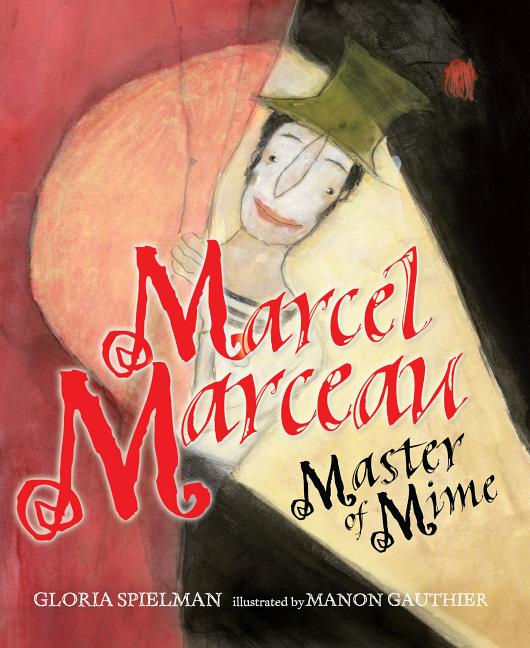
for Marcel Marceau: Master of Mime by Gloria Spielman and Manon Gauthier
Professional book information and credentials for Marcel Marceau.
- School Library Journal:
- Grades 2 - 5
- Publisher's Weekly:
- Ages 8 - 11
- Kirkus:
- Ages 8 - 10
- TeachingBooks:*
- Grades 5-8
- Word Count:
- 1,142
- Lexile Level:
- 860L
- ATOS Reading Level:
- 5.1
- Genre:
- Biography
- Nonfiction
- Picture Book
- Year Published:
- 2011
5 Subject Headings
The following 5 subject headings were determined by the U.S. Library of Congress and the Book Industry Study Group (BISAC) to reveal themes from the content of this book (Marcel Marceau).
5 Full Professional Reviews
The following unabridged reviews are made available under license from their respective rights holders and publishers. Reviews may be used for educational purposes consistent with the fair use doctrine in your jurisdiction, and may not be reproduced or repurposed without permission from the rights holders.
Note: This section may include reviews for related titles (e.g., same author, series, or related edition).
From Horn Book
January 1, 2012
Spielman's understated picture book biography covers fascinating events of Marceau's early life. At sixteen, he and his brother fled the Nazis and became active in the French Resistance. Because of his ability to entertain, Marcel was tapped to smuggle Jewish children out of France. Gauthier's softly colored line drawings perfectly capture the gentle spirit of the performer, both off and on stage.
(Copyright 2012 by The Horn Book, Incorporated, Boston. All rights reserved.)

From Horn Book
November 1, 2011
Pantomime artist Marcel Marceau's silent, white-faced character Bip is widely known throughout the world. Less known is Marceau's life story, which is just as fascinating. From the time he was a small boy in Strasbourg, France, Marcel Mangel entertained his peers by doing impressions of animals and of his favorite movie actor, Charlie Chaplin. At age sixteen, Marcel and his older brother Alain fled from the Nazis to Limoges, where they changed their last name to Marceau and became active in the French Resistance. Because of his ability to impersonate and entertain, Marcel was tapped to smuggle Jewish children out of France and into Switzerland, a dangerous trip he took many times, disguising himself and the children as scouts on their way to camp. This work eventually led to an opportunity for him to attend drama school in Paris, and there he discovered his life's passion and his profession. In 1947, he introduced the character Bip, who served as his alter ego and persona for the next sixty years. Spielman's understated picture-book biography covers all these events but focuses particularly on the actor's early years, showing how he first used his natural talents as a survival mechanism and later crafted them into an art form. Gauthier's softly colored line drawing perfectly capture the gentle spirit of Marcel Marceau, both off and on stage. kathleen t. horning
(Copyright 2011 by The Horn Book, Incorporated, Boston. All rights reserved.)
From School Library Journal
October 1, 2011
Gr 2-5-Readers are introduced to the world-famous reviver of the lost art of mime in this attractive and accessible picture-book biography. Melding Marceau's childhood and evolution as an artist with world events, Spielman reveals how the young son of a kosher butcher in Strasbourg, France, pursued his dream, despite the Nazi invasion in 1939. After his father took him to see a silent Charlie Chaplin film when he was five, "The boy was fascinated that the actor could make his audience laugh and cry without ever speaking a word. Marcel decided he would grow up to be like Charlie." After his city was evacuated, he and his older brother were sent to study art in Limoges, the center of the French Resistance. There, he used his artistic talent to doctor children's identification cards. He also led groups of Jewish children to the safety of the Swiss border; one illustration shows him with a group of young charges on a train singing heartily as a clueless Nazi soldier claps enthusiastically. After his father was sent to Auschwitz, he went to a children's home outside of Paris, where he taught art and drama. At age 20, a famous actor and director saw him perform and encouraged him to study drama. After the war, he perfected his trademark character, a role he played for the next 60 years. The final spread includes color and black-and-white photographs of the performer as Bip. Gauthier's childlike mixed-media illustrations feature myriad rosy-cheeked characters and capture both the whimsy of Marceau's performances and the more somber conditions of war-torn France.-Barbara Auerbach, PS 217, Brooklyn, NY
Copyright 2011 School Library Journal, LLC Used with permission.

From Publisher's Weekly
August 8, 2011
Reaching well beyond his role as a mime, Spielman’s (Janusz Korczak’s Children) picture-book biography puts a fascinating new face on Marceau (1923–2007), tracing his career in entertainment back to his childhood idolization of Charlie Chaplin, who “could make his audience laugh and cry without ever speaking a word.” As a boy in Strasbourg, Marcel amused peers with his impersonations of animals, but WWII changed the tenor of his life. Gauthier’s (The Tooth) airy illustrations become (at least briefly) more somber as they portray the evacuation of Marceau’s hometown, and his work with the French Resistance as a teenager, which entailed leading Jewish children across the Swiss border to safety, often disguising them as scouts on their way to camp. After his
father was deported to Auschwitz, Mar-ceau’s mother sent him to a children’s home, where he pursued his dramatic aspirations, eventually studying, perfecting, and teaching mime. Terrific photos of Marceau on stage close out this well-rounded biography and complement Gauthier’s more abstract portraits of the man who took Chaplin’s flair a step further to revive “the ancient and almost forgotten art of silence.” Ages 8–11.

From Kirkus
April 15, 2011
The legendary mime is introduced to a new generation, though not entirely successfully.
As a child, Marceau loved to silently entertain his friends, like his idol, Charlie Chaplin. During the Nazi occupation of France, Marcel and his brother took on new identities in the French Underground, where they forged documents for Jewish children and helped many to escape to Switzerland. Spielman assumes that her young audience will understand references to deportation and concentration camps; unfortunately for those that don't, her matter-of-fact tone speaks more of adventure than deadly peril. Her tone subtly changes when she lovingly describes Marceau's training and development as a mime and his stage persona of Bip the clown, admiring his skills in the "art of silence" that won him international renown. But here too, comparisons to the Little Tramp and Pierrot may be outside readers' frame of reference. Though the illustrations carefully complement the textual content with period details, Gauthier's cartoon faces are all nearly identical, with only the screen image of Chaplin and Marceau's Bip having distinctive features. A double-page spread at the conclusion provides photographs of Bip in action and is the only clear indication of Marceau's stagecraft.
At its best when the emphasis is on the skill and artistry of Mime's most accomplished practitioner--alas, too much of the book looks elsewhere. (Picture book/biography. 8-10)
(COPYRIGHT (2011) KIRKUS REVIEWS/NIELSEN BUSINESS MEDIA, INC. ALL RIGHTS RESERVED.)

Preview Digital Book
Explore Marcel Marceau on Marketplace. Access requires OverDrive Marketplace login.
This Book Resume for Marcel Marceau is compiled from TeachingBooks, a library of professional resources about children's and young adult books. This page may be shared for educational purposes and must include copyright information. Reviews are made available under license from their respective rights holders and publishers.
*Grade levels are determined by certified librarians utilizing editorial reviews and additional materials. Relevant age ranges vary depending on the learner, the setting, and the intended purpose of a book.
Retrieved from TeachingBooks on April 01, 2026. © 2001-2026 TeachingBooks.net, LLC. All rights reserved by rights holders.
