

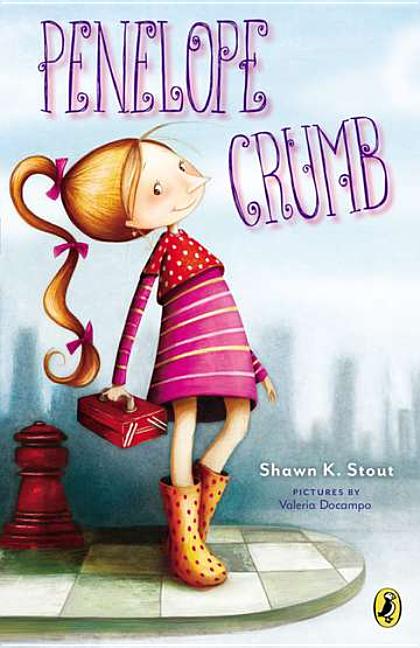
Book Resume
for Penelope Crumb by Shawn K. Stout and Valeria Docampo
Professional book information and credentials for Penelope Crumb.
- School Library Journal:
- Grades 3 - 5
- Kirkus:
- Ages 7 - 10
- School Library Journal:
- Grades 3 - 5
- School Library Journal:
- Grades 3 - 5
- Booklist:
- Grades 2 - 4
- Kirkus:
- Ages 7 - 10
- Booklist:
- Grades 3 - 5
- Kirkus:
- Ages 7 - 10
- Publisher's Weekly:
- Ages 7 - 10
- TeachingBooks:*
- Grades 1-6
- Word Count:
- 32,386
- Lexile Level:
- 730L
- ATOS Reading Level:
- 4.1
- Genre:
- Humor
- Realistic Fiction
- Year Published:
- 2012
7 Subject Headings
The following 7 subject headings were determined by the U.S. Library of Congress and the Book Industry Study Group (BISAC) to reveal themes from the content of this book (Penelope Crumb).
15 Full Professional Reviews
The following unabridged reviews are made available under license from their respective rights holders and publishers. Reviews may be used for educational purposes consistent with the fair use doctrine in your jurisdiction, and may not be reproduced or repurposed without permission from the rights holders.
Note: This section may include reviews for related titles (e.g., same author, series, or related edition).
From Horn Book
January 1, 2015
After "fake wart" avoidance tactics fail her, Penelope Crumb juggles the complexities of co-ed gym-class square dancing and cruel social dynamics in her fourth book. She may not win, but she comes out stronger, with honorable mention and new friends. While the story's overarching tie to the moon seems forced and side plots are left dangling, Penelope's take on her troubles makes enjoyable reading.
(Copyright 2015 by The Horn Book, Incorporated, Boston. All rights reserved.)
From School Library Journal
July 1, 2014
Gr 3-5-In this latest smartly written account of what it feels like to be a tween, Penelope Crumb is facing the music. Literally. Her fourth-grade gym class is being paired with (shudder) fifth graders during a unit on square dancing. Turns out, square dancing doesn't come easily to Penelope. And, showing up to the first day of lessons dressed as an elephant for animal day-on the wrong day-doesn't help win Penelope any friends with the fifth grade girls, ruled by the snarly Nancy Jo. Paired with Hugo "Lippy" Gordon (nicknamed such because of his perpetually sweaty upper lip), Penelope struggles with insecurities and her strong need to fix the situation. Turning to her beloved Grandpa Felix for advice, he advises her to sing to the moon, like he does, when he has a problem. Penelope ponders about the moon often, especially its other side that she can never glimpse. She wonders what the moon is really like, as she realizes that everyone really has two sides to them-the one that everyone on the outside can see, and the hidden side that we share only with those we love the most and trust. As she is thinking, Penelope realizes that "maybe, just maybe, the way to show Nancy Jo and everybody the whole me is to tell them what they don't know about me, what they can't see." And that, she finds out, is almost as hard to do as square dancing. Stout's series about this tween's worries, insecurities, quirkiness and wit deserves a space in library collections looking for precocious, independent girl characters who might not be perfect but are something else: realistic.-Lisa Kropp, Suffolk Cooperative Library System, Bellport, NY
Copyright 2014 School Library Journal, LLC Used with permission.
From Horn Book
January 1, 2014
In this third installment, fourth-grader Penelope Crumb worries about "the Bad Luck." Desperately wanting to drive the Bad Luck away, she gets into trouble assisting a retired Coney Island fortuneteller. The first-person narrative magnifies the wacky humor of Penelope's unique observations and phrasings, and readers can compare her (not-always-reliable) perspective with that shown in the occasional spot art.
(Copyright 2014 by The Horn Book, Incorporated, Boston. All rights reserved.)
From Kirkus
September 1, 2013
Penelope returns in her third adventure, in which she struggles with leading a community mural-painting project, helping plan the secret escape of an elderly yet feisty fortuneteller and avoiding the Bad Luck as much as possible. As in the previous books, Penelope is still coping with the loss of her Graveyard Dead dad as well as the fact that her former best friend, Patsy Cline, has a new BFF in Vera Bogg. All she wants is to be someone's Favorite and to benefit from some Good Luck, but she knows that the Bad Luck is perpetually waiting (like "surprise test[s] on decimal points"). Perhaps it's a sign her luck is changing for the better when she is voted to lead the Mother Goose mural painting at the Portwaller's Blessed Home for the Aging, but she soon discovers being the boss isn't so easy. Stout populates her story with appealing characters who shine in both snappy dialogue and Penelope's wry yet winsome first-person narration. A lost lucky charm, a reception revealing a most unusual interpretation of Mother Goose and a foiled getaway all lead to the realization that what matters most is having people around who value you for who you are and that "things don't always stay the same"--and that many times, "that could be a good thing." Although full of candies and melting Popsicles, this sweet tale is refreshing rather than cloying. (Fiction. 7-10)
COPYRIGHT(2013) Kirkus Reviews, ALL RIGHTS RESERVED.
From Horn Book
September 1, 2013
In this third series installment, fourth grader Penelope Crumb worries about luck, specifically "the Bad Luck." As she finds her role evolving among her classmates, friends, and family, she fights change and brings a lot of that Bad Luck on herself. An unexpected extracurricular project creating a mural at Portwaller's Blessed Home for the Aging finally allows Penelope an opportunity to shine as an artist, and she is elected group leader. (Unfortunately, she's deposed almost immediately.) The first-person narrative magnifies the wacky humor of Penelope's unique observations and phrasings, and readers can compare her (not-always-reliable) perspective with that shown in the occasional spot art. Desperately wanting to find a charm that will drive the Bad Luck away (and to be someone's "Favorite"), she gets herself into real trouble assisting a resident of the old-age home (a retired Coney Island fortuneteller whose own bossiness is a match for Penelope's). Penelope, frustrating but always likable, never does recognize that people often make their own luck, but the evidence is there for savvy readers to notice. julie roach
(Copyright 2013 by The Horn Book, Incorporated, Boston. All rights reserved.)
From School Library Journal
August 1, 2013
Gr 3-5-In the third book in this charming series, fourth-grader Penelope Crumb has enjoyed thinking she is the Favorite of Grandpa Felix, her mom, and best friend Patsy Cline, but maybe she's caught "the Bad Luck... it's a lot like catching the stomach flu." Grandpa has asked her brother Terrence "Terrible" to help with a photography shoot, her mom says that moms don't have Favorites, and Patsy has been spending time with Vera Bogg. When Penelope has the chance to be in charge of a Mother Goose mural her class is painting for a home for the aged, she jumps at the opportunity, thinking it will make her everyone's Favorite. But the project doesn't go according to plan, and when she befriends an old woman at the home who promises to help find her luck, things take a turn for the worse. Penelope and her classmates must learn to work together to finish the project before the unveiling party, and she learns that being the Favorite is less important than being loved. Black-and-white line drawings help bring out Penelope Crumb's quirky and endearing personality. Fans of Clementine and Ramona Quimby will feel right at home with her.-Sarah Polace, Cuyahoga Public Library System, OH
Copyright 2013 School Library Journal, LLC Used with permission.
From Horn Book
July 1, 2013
Never without her deceased father's old toolbox, Penelope knows all about trying to hold on to those you've lost, but when her best friend buys a "friends forever" necklace with another girl, she discovers that even living people are hard to hold on to. Penelope comes more into her own in this breezy chapter book sequel to Penelope Crumb.
(Copyright 2013 by The Horn Book, Incorporated, Boston. All rights reserved.)
From School Library Journal
March 1, 2013
Gr 3-5-Penelope again embarks on adventures that are both troublesome and outlandish. Since her father passed away, she has had a fascination with what she calls Graveyard Dead. On the school field trip to the town museum, where the other kids are more interested in the gift shop than in the artifacts, Penelope becomes enraged and vows to never let the important people in her life be forgotten. She also becomes jealous when her best friend, Patsy Cline, shares in the tradition of wearing best-friends-forever necklaces with Vera Bogg. Later, Patsy loses her necklace and Penelope finds it and adds it to the museum she has created in her closet so she will never forget. Penelope then goes about collecting things that are very important to the living people in her life. Now she is in trouble and relies on her older friend Littie to help her out of this predicament. While the writing and character development are very good, Penelope Crumb is just a little too quirky. With an unresolved ending between Penelope and Patsy and the fact that this fourth grader goes all over town alone, the book is less than satisfying. The occasional line drawings add little, and children unfamiliar with Penelope Crumb (Philomel, 2012) will have trouble connecting all the dots in this one. Purchase only if the first book is popular.-Nancy Jo Lambert, Ruth Borchardt Elementary, Plano, TX
Copyright 2013 School Library Journal, LLC Used with permission.
From Horn Book
January 1, 2013
Fourth-grader Penelope Crumb joins the growing party of precocious, idiosyncratic girls starring in early chapter books. Penelope wants to be an artist, believes aliens abducted her older brother, struggles to fit into the classroom environment, and has just embraced the reality of her very large nose. Occasional spot art offers visual perspective as first-person narrator Penelope seems prone to exaggeration.
(Copyright 2013 by The Horn Book, Incorporated, Boston. All rights reserved.)
From Booklist
December 15, 2012
Grades 2-4 This time out, the preoccupation with Penelope's large nosea big deal in Penelope Crumb (2012)gives way to the preoccupation with the possible loss of her best friend, who is becoming annoyingly attached to another fourth-grade girl. With Penelope's dad Graveyard Dead, as she puts it, another loss would be difficult to bear. Trying to figure out how to honor people and to fix the best-friend situation, Penelope takes action, not always wisely but always divertingly. Stout again provides Penelope with a lack of social savvy but at least gives her enough sympathetic adults to balance out the few, including her teacher, who don't appreciate Penelope's eccentricities.(Reprinted with permission of Booklist, copyright 2012, American Library Association.)
From Kirkus
December 1, 2012
Penelope Crumb is back with the same spunk and quirky narration that won readers over in her eponymous debut (2012). Still struggling with the reality that her dad is Graveyard Dead, Penelope must also contend with a rival for her best friend Patsy Cline's attention. New on the scene is perpetually-in-pink Vera Bogg, who wants to be Patsy's new BFF. When Penelope realizes that Patsy might actually prefer being Vera's best friend instead of hers, she finds herself coping with another potential loss. Grandpa Felix, dealing with some changes in his own life, dispenses wisdom such as "Nothing is forever" and "Sometimes you just have to let go." Inspired by a school field trip and fueled by her need to hold onto some part of all the people she loves, Penelope empties out her closet and makes it into her "Ultra Museum of Forget-Me-Notters." Kids will completely understand the odd items she chooses to include: her lost teeth (some with blood still on them!), strands of Patsy Cline's hair, her dad's shoehorn, her mother's self-portrait, her brother's drawings and Grandpa Felix's beloved camera, Alfred. Unfortunately her good intentions are misinterpreted as thefts or worse. But Penelope stays true to herself and learns how to fix what she can while adjusting her expectations for the future. Readers will root for and relate to this fresh-voiced young heroine who joins the likes of Ramona, Judy Moody and Clementine. (Fiction. 7-10)
COPYRIGHT(2012) Kirkus Reviews, ALL RIGHTS RESERVED.
From Booklist
August 1, 2012
Grades 3-5 Like such popular fourth-grade narrators as Amber Brown and Lucy Rose, Penelope Crumb has definite ideas and big dreams. She aspires to be like Leonardo da Vincior, as she clarifies, I want to be a famous artist, too, but not a dead one. Unlike the aforementioned narrators, Penelope discovers she has a nose to match those big dreams, which becomes a major plot point when Penelope tries to find the estranged grandfather whose large nose she has inherited. The author of the Fiona Finkelstein books, Stout handles Penelope, her nose, and her relationships with friends and family with sensitivity and humor. She has Penelope make unusual choicesskipping school, going to strange neighborhoodswithout serious consequences, but, ultimately, Penelope's desires to connect with her relatives (even the 14-year-old brother who has changed so much she considers him an alien) bring the Crumb family together in a sweet and satisfying way. Docampo's illustrations nicely capture Penelope's happy distinctiveness.(Reprinted with permission of Booklist, copyright 2012, American Library Association.)
From Kirkus
July 1, 2012
Penelope Crumb's large nose links her to her mysterious grandfather, who, it turns out, is not Graveyard Dead. When fourth-grade artist and would-be gumshoe Penelope Crumb realizes she has a large nose, everyone, especially her older brother Terrible (really Terrence), laughs it off. How can she not have known? Her mother states that it is Penelope's late father's nose, and the girl is pleased to be linked to him. But when her mother throws out a comparison to her Grandpa Felix's honker, Penelope is surprised that her grandfather is not dead. He just has not been part of the family since Penelope's father got sick. This casual comment, and a class assignment about family stories, sends the youngest Crumb on a quest to find this mysterious Grandpa Felix. Told in a fresh, amusing first-person voice, Penelope is part adventurer (she and her best friend skip school, take trains and knock on strangers' doors in their search), part private investigator and part therapist as she tries to piece together the missing parts of her family's story. Her mother, a medical illustrator, is mostly in the background, studying and drawing and getting over her husband's death, but she succumbs to Penelope's powers by the end. Fans of Clementine and Ramona will cheer as new friend Penelope finds what she is looking for. (Fiction. 7-10)
COPYRIGHT(2012) Kirkus Reviews, ALL RIGHTS RESERVED.
From Horn Book
July 1, 2012
Joining the growing party of precocious, idiosyncratic girls starring in early chapter books, fourth-grader Penelope Crumb showily introduces herself to new readers. She wants to be an artist, believes aliens abducted her older brother, struggles to fit into the classroom environment, and has just embraced the reality of her very large nose. Occasional spot art extends the story and offers readers some true visual perspective as first-person narrator Penelope seems prone to exaggeration. For an assignment Penelope must find out more about her family history and make a coat of arms ("An arm coat?' I say. You mean with elbows and everything?'"), but having a dead father, estranged grandfather, and unforthcoming mother makes this difficult. Using the nose she inherited from her grandfather, Penelope decides to go after the answers herself. Penelope's flighty spirit and literal interpretation of the world around her lighten the mood of her family's sad past. Much about Penelope Crumb feels overly familiar, but readers who enjoy this genre will be pleased to make her acquaintance. julie roach
(Copyright 2012 by The Horn Book, Incorporated, Boston. All rights reserved.)
From Publisher's Weekly
June 25, 2012
In this auspicious series launch, fourth-grader Penelope first learns that she has an oversize nose in art class. When a distraught Penelope shares this information with her mother, Penelope learns that she has the "Crumb nose" like her Grandpa Felix, who Penelope had always believed was "Graveyard Dead" like her father. This revelation, along with a school assignment to create a family coat of arms, sends Penelope on a search for her grandfather. After a few red herrings, Penelope finds Grandpa Felix and uncovers some family history. Stout (the Fiona Finkelstein books) deals with serious topics, such as the hole left in Penelope's life by her father's death, with a light touch, giving Penelope a memorable narrative voice full of quirks. (An aspiring artist, Penelope is "real good at telling what different kinds of faces mean," so she fully recognizes when her mother is giving her "a look that says, We Are Not Going to Talk About This Anymore.") Docampo contributes angular and stylized b&w images of Penelope (and her beaky schnoz) that add to the heroine's considerable personality. Ages 7â€"10. Agent: Sarah Davies, Greenhouse Literary Agency.
Preview Digital Book
Explore Penelope Crumb on Marketplace. Access requires OverDrive Marketplace login.
This Book Resume for Penelope Crumb is compiled from TeachingBooks, a library of professional resources about children's and young adult books. This page may be shared for educational purposes and must include copyright information. Reviews are made available under license from their respective rights holders and publishers.
*Grade levels are determined by certified librarians utilizing editorial reviews and additional materials. Relevant age ranges vary depending on the learner, the setting, and the intended purpose of a book.
Retrieved from TeachingBooks on April 01, 2026. © 2001-2026 TeachingBooks.net, LLC. All rights reserved by rights holders.
