

Book Resume
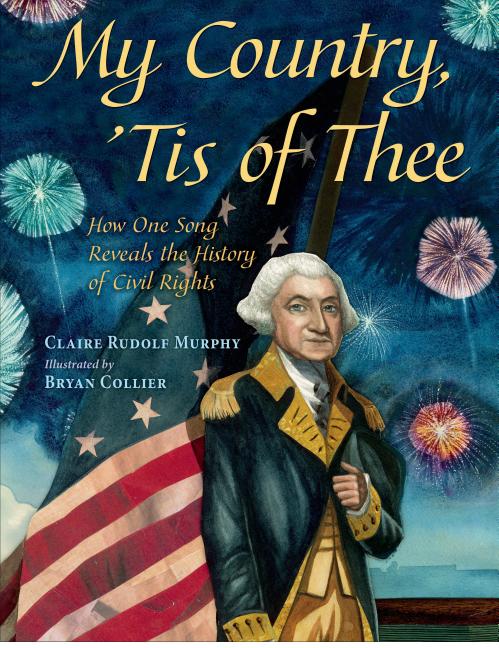
for My Country, 'Tis of Thee: How One Song Reveals the History of Civil Rights by Claire Rudolf Murphy and Bryan Collier
Professional book information and credentials for My Country, 'Tis of Thee.
6 Professional Reviews
3 Book Awards
Selected for 1 State/Province List
A fascinating look at the history of the song “America” (“My Country ...read more
- Booklist:
- Grades 3 - 5
- Kirkus:
- Ages 5 - 9
- School Library Journal:
- Grades 5 - 7
- Publisher's Weekly:
- Ages 5 - 9
- TeachingBooks:*
- Grades 3-8
- Word Count:
- 1,760
- Lexile Level:
- 1000L
- ATOS Reading Level:
- 5.5
- Genre:
- Nonfiction
- Year Published:
- 2014
11 Subject Headings
The following 11 subject headings were determined by the U.S. Library of Congress and the Book Industry Study Group (BISAC) to reveal themes from the content of this book (My Country, 'Tis of Thee).
- Children's Books/Ages 4-8 Nonfiction
- Juvenile Nonfiction | History | United States - General
- Political ballads and songs
- God save the King--Juvenile literature
- Smith, Samuel Francis, 1808-1895. America--Juvenile literature
- Juvenile Nonfiction | Music | History
- Smith, Samuel Francis
- History and criticism
- Political ballads and songs--United States--History and criticism--Juvenile literature
- United States
- Juvenile Nonfiction | Social Topics | Prejudice & Racism
6 Full Professional Reviews
The following unabridged reviews are made available under license from their respective rights holders and publishers. Reviews may be used for educational purposes consistent with the fair use doctrine in your jurisdiction, and may not be reproduced or repurposed without permission from the rights holders.
Note: This section may include reviews for related titles (e.g., same author, series, or related edition).
From Cooperative Children's Book Center (CCBC)
A fascinating look at the history of the song “America” (“My Country ’Tis of Thee”) begins with its roots in England in the 1740s, as “God Save the King.” It was adapted for use in the American colonies as they sought independence, with new words written for the new cause. From those times on, the song has been a part of various struggles for equality and justice. Verses were penned in the fight against slavery and for the right of women and Native Americans to vote. Marian Anderson sang “America” at the Lincoln Memorial in 1939 after being denied the opportunity to sing at Constitution Hall because she was Black. Martin Luther King, Jr. referenced the song in his speech at the March on Washington in 1963. And when Barack Obama was elected president, Aretha Franklin sang it at his first inauguration in 2009. “Now it’s your turn. Write a new verse for a cause you believe in. Help freedom ring.” Ample notes and source material conclude this inspired volume. (Ages 8–12)
CCBC Choices 2015 © Cooperative Children's Book Center, Univ. of Wisconsin - Madison, 2015. Used with permission.
From Horn Book
July 1, 2014
A variety of groups--American colonists, slaves, suffragists, civil rights advocates, and more--have invoked this familiar tune to comfort and exhort their followers. Collier's signature watercolor and collage illustrations gently extend the evolving lyrics and add historical details. Teachers will enjoy sharing this book as it encourages youngsters to write a new verse "for a cause you believe in." Reading list, websites. Bib.
(Copyright 2014 by The Horn Book, Incorporated, Boston. All rights reserved.)
From Booklist
June 1, 2014
Grades 3-5 This unusual picture book traces the history of the song that is usually referred to by its first line, My country, 'tis of thee (the song's true title is America). Murphy suggests that the changes made to the lyrics in different periods create a narrative of civil rights in America. Originally an English song from the 1740s (God Save the King), it inspired new, more revolutionary verses as colonial America moved toward independence. Later, activists adapted the song to promote a variety of causes, including the abolition of slavery, voting rights for women, workers' rights, and civil rights for African Americans. The text creates a sweeping sense of history, culminating with Aretha Franklin singing America at President Obama's inauguration and urging children to write a new verse for a cause you believe in. Collier's atmospheric collages of paintings and photos create richly textured effects as well as some iconic portraits, while the settings and dress in the artwork will help readers envision the swift shifts from one period to the next. An intriguing new take on a beloved patriotic song.(Reprinted with permission of Booklist, copyright 2014, American Library Association.)
From Kirkus
May 1, 2014
One of the first patriotic songs young Americans learn in school is "America," more commonly known as "My Country, 'Tis of Thee."At some point, many also learn it shares its melody with the British anthem, "God Save the Queen." What is not so familiar is how several different versions of the words have appeared through the years and how many groups and movements used these versions to fuel their efforts for expanded rights. From the tune's first appearance in 1740s England as a way to support the monarch, during the Revolutionary War and beyond, lyrics were written and rewritten to reflect sometimes-conflicting causes. Murphy introduces various movements seeking civil rights and how they crafted verses to suit their particular causes. Short paragraphs provide context to introduce the variations, while single sentences in a larger type punctuate each spread. Readers are encouraged not only to learn about the song, but to write their own verses. Collier's watercolor-and-collage illustrations provide an additional level of understanding and complement the narrative. Detailed backmatter, including extensive source notes, bibliography, resource list (including musical links), make this an enlightening addition to social history.This examination of a well-known piece of music and the activism it inspired makes for a fascinating way to explore history. (Informational picture book. 5-9)
COPYRIGHT(2014) Kirkus Reviews, ALL RIGHTS RESERVED.
From School Library Journal
May 1, 2014
Gr 5-7-A familiar patriotic song culminates in a hymn to "Great God Our King," having long ago originated as a tribute to England's King George II. Through two centuries, many different texts were used by groups for whom freedom didn't ring. Murphy's subtitle introduces this collection of variants. The chronological string of historical points begins in 18th-century England and moves through protests of the colonists, the Revolutionary War, and subsequent lack of freedoms and full citizenship for women, slaves, Native Americans, and people of color until well after the Civil War. Double-page entries include a short bit of history and a related verse of a protest song set against Collier's watercolor and collage scenes and portraits of individuals and groups. The view is most often somber, with dark and neutral tones occasionally brightened with a bit of deep blue. The presentation culminates with Marian Anderson's 1939 Lincoln Memorial performance upon being shut out of Constitution Hall, the rise of Martin Luther King, Jr., and Aretha Franklin's singing at the inauguration of Barack Obama. Finally, readers are invited to "Write a new verse for a cause you believe in. Help freedom ring." The invitation is laudable, and some of the songs are clear and compelling. Others seem quaint or even murky for a young audience: "Let Freedom's voice prevail, /And draw aside the veil, /Supreme Effulgence hail, /Sweet Liberty." The book concludes with brief notes about each entry and the music and verses of "My Country 'Tis of Thee." The sketchy outline of civil rights history could serve as an introduction for some readers or classrooms. Creative music teachers might also use it to explore the larger realm of protest songs.-Margaret Bush, Simmons College, Boston
Copyright 2014 School Library Journal, LLC Used with permission.
From Publisher's Weekly
April 14, 2014
"More than any other, one song traces America's history of patriotism and protest." Murphy's (Marching with Aunt Susan) sweeping opening line sets the stage for subsequent examples of how marginalized groups have adopted and changed the song, "My Country, 'Tis of Thee." A straightforward narrative examines the song's various versions. Beginning in 1700s England as an anthem supporting King George II, the melody was put to use across the sea in the Revolutionary and Civil Wars, along with the abolitionist, farmworkers', suffragist, Native American, and Civil Rights movements. Collier's (Knock, Knock) striking full-spread collages invite close inspection. Layered textures and hues, photographs, and intricate paper designs create eye-catching and sometimes haunting illustrations. In one scene, runaway slaves escape through dark woods, the silhouettes of African-American children's faces forming mountains and shrubs. A boy's face stares out at readers from a hole in a tree trunk, as faded, anguished faces blend into the bark. "My country, 'tis for thee,/ Dark land of slavery,/ For thee I weep." Source notes offer more details about each spread, and a bibliography and resource list are included. Ages 5—9. Author's agent: Kendra Marcus, Bookstop Literary Agency. Illustrator's agent: Marcia Wernick, Wernick & Pratt. (June)â—
3 Book Awards & Distinctions
My Country, 'Tis of Thee was recognized by committees of professional librarians and educators for the following book awards and distinctions.
 CCBC Choices, Selection, 2015
 Notable Social Studies Trade Books for Young People, 2015-2026, History, Life, Culture in the Americas Selection, 2015
 Junior Library Guild Selections, 2012-2026, Nonfiction Selection, 2014
1 Selection for State & Provincial Recommended Reading Lists
My Country, 'Tis of Thee was selected by educational and library professionals to be included on the following state/provincial reading lists.
United States Lists (1)
Washington
- William C. Towner Student Award for Informational Text, 2016, Grades 2-6
Preview Digital Book
Explore My Country, 'Tis of Thee on Marketplace. Access requires OverDrive Marketplace login.
This Book Resume for My Country, 'Tis of Thee is compiled from TeachingBooks, a library of professional resources about children's and young adult books. This page may be shared for educational purposes and must include copyright information. Reviews are made available under license from their respective rights holders and publishers.
*Grade levels are determined by certified librarians utilizing editorial reviews and additional materials. Relevant age ranges vary depending on the learner, the setting, and the intended purpose of a book.
Retrieved from TeachingBooks on April 01, 2026. © 2001-2026 TeachingBooks.net, LLC. All rights reserved by rights holders.
