

Book Resume
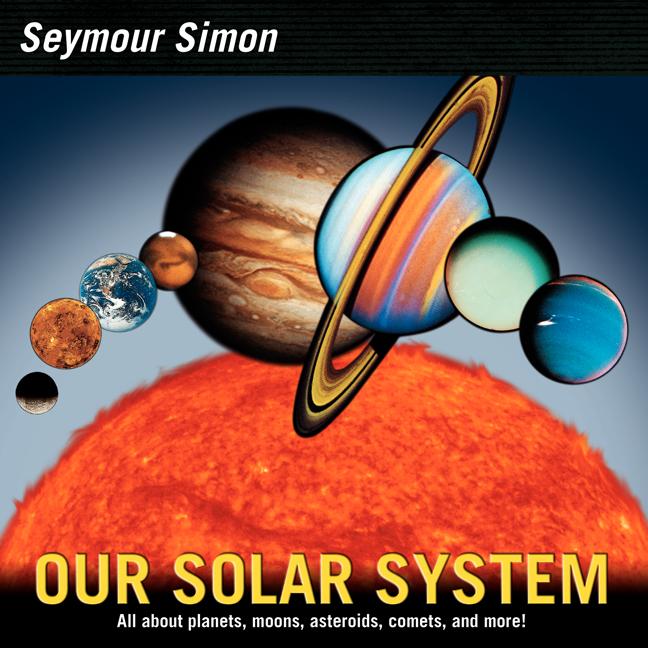
for Our Solar System by Seymour Simon
Professional book information and credentials for Our Solar System.
- School Library Journal:
- Grades 3 - 6
- TeachingBooks:*
- Grades 1-6
- Word Count:
- 4,194
- Lexile Level:
- 1020L
- ATOS Reading Level:
- 5.9
- Genre:
- Nonfiction
- Year Published:
- 2014
7 Subject Headings
The following 7 subject headings were determined by the U.S. Library of Congress and the Book Industry Study Group (BISAC) to reveal themes from the content of this book (Our Solar System).
2 Full Professional Reviews
The following unabridged reviews are made available under license from their respective rights holders and publishers. Reviews may be used for educational purposes consistent with the fair use doctrine in your jurisdiction, and may not be reproduced or repurposed without permission from the rights holders.
Note: This section may include reviews for related titles (e.g., same author, series, or related edition).
From Horn Book
January 1, 2015
The culmination of Simon's planets series is a fine, comprehensive work on the solar system. Similar to the others in format, the book brings together information on all the planets, a good comparison chart, and typically excellent color photographs. Beautifully designed and a pleasure to use, this latest edition is updated with information from recent explorations. Websites. Glos., ind.
(Copyright 2015 by The Horn Book, Incorporated, Boston. All rights reserved.)
From School Library Journal
October 1, 2014
Gr 3-6-Revised and updated, this edition takes readers on a journey through the solar system with upgraded photos, content, and glossary from its predecessors (1992, 2007). While much of the content remains the same as the previous edition, small details have been adjusted, such as Jupiter's clouds, which are no longer "mostly hydrogen gas, not water droplets like clouds on Earth" but are now simply "frozen ammonia droplets." Although these details may be nearly imperceptible to young readers, what will stand out are the captivating photographs. The images, many of which are from NASA, are remarkably crisp and more detailed than before, giving a nod to changes in imaging technology in the past decade. As stated in the author's note, Simon uses comparisons to help readers comprehend the scale of these celestial masses ("If Earth were the size of a basketball, the sun would be as big as a basketball court."). He does not return the favor for specific calculations, though, thus leaving readers to grapple with the meaning of "the crust, which ranges from 5 to 30 miles deep" and "the mantle, an 1,800-mile-thick layer of heavy rock." Furthermore, some words do not appear in the glossary, such as typhoon and asteroid, and the unexplained transition from "800 degrees Fahrenheit" to "-300F" may confuse some readers. However, the brief overview of the solar system and the spacecraft sent to explore it make this title a worthwhile consideration for school and public libraries.-Meaghan Darling, Plainsboro Public Library, NJ
Copyright 2014 School Library Journal, LLC Used with permission.
Preview Digital Book
Explore Our Solar System on Marketplace. Access requires OverDrive Marketplace login.
This Book Resume for Our Solar System is compiled from TeachingBooks, a library of professional resources about children's and young adult books. This page may be shared for educational purposes and must include copyright information. Reviews are made available under license from their respective rights holders and publishers.
*Grade levels are determined by certified librarians utilizing editorial reviews and additional materials. Relevant age ranges vary depending on the learner, the setting, and the intended purpose of a book.
Retrieved from TeachingBooks on April 01, 2026. © 2001-2026 TeachingBooks.net, LLC. All rights reserved by rights holders.
