

Book Resume
for Like a Bird: The Art of the American Slave Song by Cynthia Grady and Michele Wood
Professional book information and credentials for Like a Bird.
5 Professional Reviews (1 Starred)
1 Book Award
Selected for 1 State/Province List
The American Slave Song, or Spiritual, derives from the experience of enslaved Africans. ...read more
- School Library Journal:
- Grades 4 and up
- Kirkus:
- Ages 5 - 10
- Booklist:
- Grades 3 - 6
- TeachingBooks:*
- Grades 3-12
- Word Count:
- 1,685
- Lexile Level:
- 1060L
- ATOS Reading Level:
- 6.3
- Cultural Experience:
- African American
- Genre:
- Nonfiction
- Year Published:
- 2017
1 Subject Heading
The following 1 subject heading were determined by the U.S. Library of Congress and the Book Industry Study Group (BISAC) to reveal themes from the content of this book (Like a Bird).
5 Full Professional Reviews (1 Starred)
The following unabridged reviews are made available under license from their respective rights holders and publishers. Reviews may be used for educational purposes consistent with the fair use doctrine in your jurisdiction, and may not be reproduced or repurposed without permission from the rights holders.
Note: This section may include reviews for related titles (e.g., same author, series, or related edition).
From Cooperative Children's Book Center (CCBC)
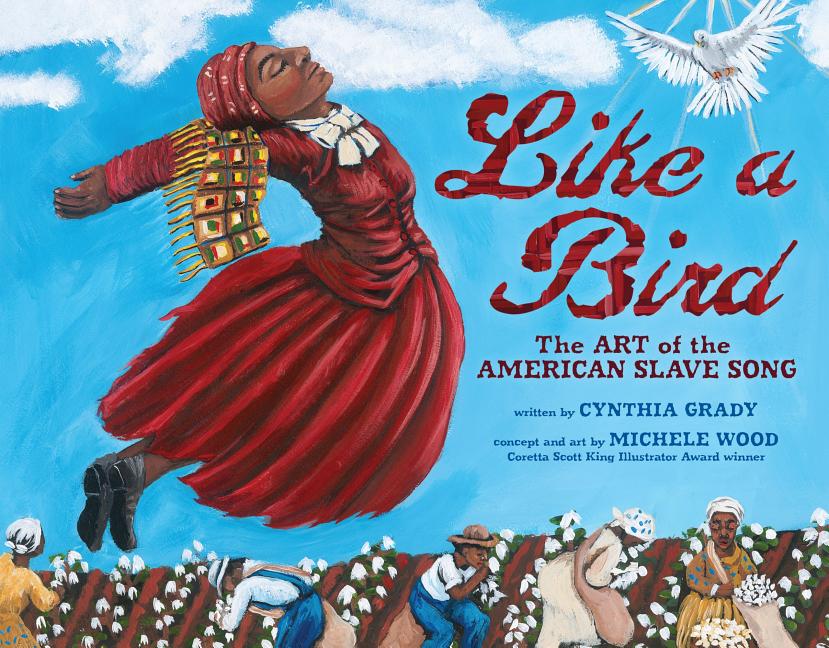
The American Slave Song, or Spiritual, derives from the experience of enslaved Africans. A mix African rhythms and instrumentation with Christian-inspired hymns, they express pain, fear, and anger, as well as hope, resourcefulness, love, and faith. Thirteen of these songs serve as the inspiration for Michele Wood’s richly detailed, powerful art. Wood’s paintings in intense shades of blue, brown, and green have repeated motifs of struggle, persistence, and strength, with images of quilting, trees, fish, and the dove that graces every page. Grady’s narrative provides historical and cultural context and connections for the slave song that inspired each work of art. Generous end matter, including notes on the design of the book, lyrics to the spirituals, a glossary, and a brief bibliography, as well as print and online resources for further reading, enrich the reading experience and offer opportunities for further understanding of the subject. (Ages 9–14)
CCBC Choices 2017 © Cooperative Children's Book Center, Univ. of Wisconsin - Madison, 2017. Used with permission.
From Horn Book
January 1, 2017
Thirteen spreads each focus on a famous spiritual and include interpretations and background information, the musical score, and an acrylic painting inspired by it; "some of the earliest recorded" lyrics to each are appended. Wood's powerful folk art is an excellent focal point for this useful introduction to the American slave experience and the resultant musical form. Reading list, websites. Bib., glos.
(Copyright 2017 by The Horn Book, Incorporated, Boston. All rights reserved.)

From School Library Journal
Starred review from September 1, 2016
Gr 4 Up-"Slaves sing most when they are most unhappy. The songs of the slave represent the sorrows of his heart." These words by Frederick Douglass are offered in an endnote to provide context for the 13 spirituals included in this volume. Readers will learn how the book began, with Wood's acrylic paintings inspired by the songs; the author then studied the paintings and researched the songs before writing the text. Each spread features a painting on the recto and one or two paragraphs of text along with the music and verses on the verso. There is also a full-spread painting of a group of slaves riding a metaphorical railroad conducted by Harriet Tubman preceding the spread for the song "Get on Board-the Gospel Train," which also includes an archival photo of Tubman. Some of the songs will be familiar, such as "Michael, Row the Boat Ashore" and "Swing Low, Sweet Chariot," while others, like "Ain't Gonna Study War No More," "Go Down, Moses," and "Nobody Knows the Trouble I've Seen," will resonate with older readers. The vibrant paintings often incorporate quilting motifs and historical events. Original lyrics are featured in the back matter. An archival photo of the Jubilee Singers of Fisk University in Nashville, TN, who popularized the spiritual as a musical form in the 1870s, appears in the introduction. VERDICT This is an excellent resource for music and art teachers as well as for social studies and U.S. history lessons.-Barbara Auerbach, New York City Public Schools
Copyright 2016 School Library Journal, LLC Used with permission.

From Kirkus
July 1, 2016
When children see Harriet Tubman on the new U.S. postage stamp, they can learn of her legacy from this literary homage to "the Moses of her people." A compilation of 13 Negro spirituals that originated in American slavery, this volume offers sheet music for each song alongside a brief commentary about its biblical and/or historical origins. Wood accompanies each song with colorful images that echo the slave past and both identify some of the hardships faced and also point to rays of hope that existed for them. In several of these commentaries, Grady asks readers questions to encourage them to explore the images more closely or to think more deeply about what it might have meant to be enslaved. On nearly every page appears a white dove, which echoes Harriet Tubman's dreams of flying "over the landscape 'like a bird' " to freedom. Unlike the portrayal of slaves in a few recent controversial picture books, the slaves depicted here rarely smile and often look distraught and somber--except on the page accompanying the final freedom song. In addition to learning about Tubman, readers will glean important historical tidbits about others such as Nat Turner, James Lafayette, abolitionist John Rankin, and Abraham Lincoln. Backmatter offers further reading suggestions, a glossary of relevant terms, and websites. An important work that gives new life to old and important songs. (Informational picture book. 5-10)
COPYRIGHT(2016) Kirkus Reviews, ALL RIGHTS RESERVED.

From Booklist
July 1, 2016
Grades 3-6 Beautiful illustrations and short, informative paragraphs come together to tell the history of songs that became American slave songs. The book opens by introducing readers to slave songs and describing how they transformed into spirituals. Thirteen spirituals are featured here, and the descriptions, which include historical, biographical, and biblical context, are all accompanied by evocative paintings. Each paragraph invites readers to notice themes in the paintings that are repeated in the lyrics and raises questions to encourage critical engagement with the text. Wood's gorgeous paintings are full of saturated colors and evocative imagerysuch as luminous blue water resembling stained glassthat tie together the concepts at hand. Sheet music and lyrics are included for each tune, and the back matter contains more lyrics, a comprehensive glossary, and lots of suggestions for further reading. A brief note explains that although slaves sang these songs, that does not mean they felt happy. While excellent for music classes, the wealth of historical context makes this a good pick for lessons on the history of U.S. slavery as well.(Reprinted with permission of Booklist, copyright 2016, American Library Association.)

1 Book Awards & Distinctions
Like a Bird was recognized by committees of professional librarians and educators for the following book awards and distinctions.
 CCBC Choices, Selection, 2017
1 Selection for State & Provincial Recommended Reading Lists
Like a Bird was selected by educational and library professionals to be included on the following state/provincial reading lists.
United States Lists (1)
New Mexico
- Land of Enchantment Coyote Reading List, 2017-2018 for Grades 3-5
Preview Digital Book
Explore Like a Bird on Marketplace. Access requires OverDrive Marketplace login.
This Book Resume for Like a Bird is compiled from TeachingBooks, a library of professional resources about children's and young adult books. This page may be shared for educational purposes and must include copyright information. Reviews are made available under license from their respective rights holders and publishers.
*Grade levels are determined by certified librarians utilizing editorial reviews and additional materials. Relevant age ranges vary depending on the learner, the setting, and the intended purpose of a book.
Retrieved from TeachingBooks on April 01, 2026. © 2001-2026 TeachingBooks.net, LLC. All rights reserved by rights holders.
