

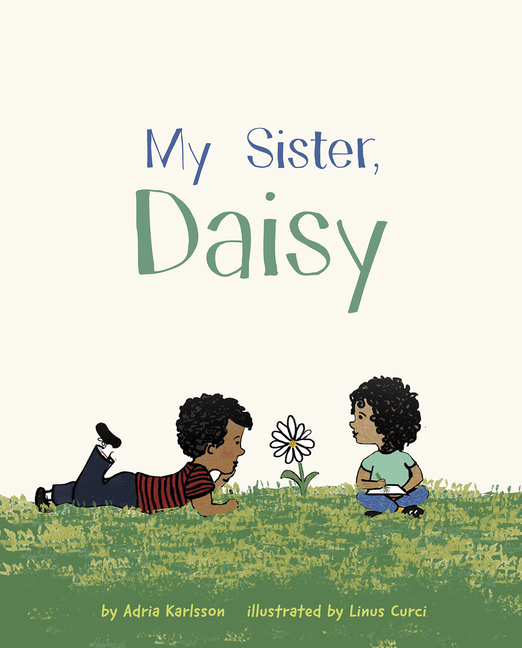
Book Resume
for My Sister, Daisy by Linus Curci and Adria Karlsson
Professional book information and credentials for My Sister, Daisy.
- Grade Levels:*
- Grades PK-2
- Word Count:
- 825
- Lexile Level:
- 510L
- ATOS Reading Level:
- 2.8
- Cultural Experience:
- LGBTQ+
- Transgender / Non-Conforming
- Genre:
- Picture Book
- Year Published:
- 2021
2 Subject Headings
The following 2 subject headings were determined by the U.S. Library of Congress and the Book Industry Study Group (BISAC) to reveal themes from the content of this book (My Sister, Daisy).
2 Full Professional Reviews
The following unabridged reviews are made available under license from their respective rights holders and publishers. Reviews may be used for educational purposes consistent with the fair use doctrine in your jurisdiction, and may not be reproduced or repurposed without permission from the rights holders.
Note: This section may include reviews for related titles (e.g., same author, series, or related edition).
From Horn Book
September 1, 2021
In an emotionally honest first-person text, an older brother reflects on how his younger sibling's gender transition has affected him. The unnamed narrator addresses his sibling, who, for the pair's first few years together, he knew as his brother: "We were brothers and best friends." When the younger child informs her family that she's a girl, the brother needs to process what's changed -- and what hasn't. The kids' parents take the news in stride, asking about a new name ("My name is Daisy, like the flower") and making sure to find an affirming community of similar families. The narrator, however, struggles with an understandable sense of loss and confusion. "I was afraid to call you by a new name and afraid to not have a brother anymore. I was afraid it meant losing you. But...I tried it." Curci's painterly illustrations, recalling Ken Wilson-Max's style (Astro Girl, rev. 11/19) with a more muted palette and less-heavy black line, skillfully convey relationships in this mixed-race family. In a particularly effective spread, the right-hand page shows Mom, Dad, and Daisy gathered around a kitchen island, the parents listening attentively to their daughter. On the verso, the narrator sits apart from the rest of his family, listening but not engaged in the conversation -- a great depiction of how children can feel left out and resentful of the attention a transitioning sibling often receives. Karlsson's text is purposeful but authentic to a child's voice, and the story (inspired by her own family's experience, we learn in an author's note) should support and guide kids in similar circumstances. With time and parental guidance, the older brother realizes "that you were still the same person, and we could play all the same games." And that's what matters most. Kitty Flynn
(Copyright 2021 by The Horn Book, Incorporated, Boston. All rights reserved.)

From Horn Book
July 1, 2021
In an emotionally honest first-person text, an older brother reflects on how his younger sibling's gender transition has affected him. The unnamed narrator addresses his sibling, who, for the pair's first few years together, he knew as his brother: "We were brothers and best friends." When the younger child informs her family that she's a girl, the brother needs to process what's changed -- and what hasn't. The kids' parents take the news in stride, asking about a new name ("My name is Daisy, like the flower") and making sure to find an affirming community of similar families. The narrator, however, struggles with an understandable sense of loss and confusion. "I was afraid to call you by a new name and afraid to not have a brother anymore. I was afraid it meant losing you. But...I tried it." Curci's painterly illustrations, recalling Ken Wilson-Max's style (Astro Girl, rev. 11/19) with a more muted palette and less-heavy black line, skillfully convey relationships in this mixed-race family. In a particularly effective spread, the right-hand page shows Mom, Dad, and Daisy gathered around a kitchen island, the parents listening attentively to their daughter. On the verso, the narrator sits apart from the rest of his family, listening but not engaged in the conversation -- a great depiction of how children can feel left out and resentful of the attention a transitioning sibling often receives. Karlsson's text is purposeful but authentic to a child's voice, and the story (inspired by her own family's experience, we learn in an author's note) should support and guide kids in similar circumstances. With time and parental guidance, the older brother realizes "that you were still the same person, and we could play all the same games." And that's what matters most.
(Copyright 2021 by The Horn Book, Incorporated, Boston. All rights reserved.)
2 Book Awards & Distinctions
My Sister, Daisy was recognized by committees of professional librarians and educators for the following book awards and distinctions.
 Notable Social Studies Trade Books for Young People, 2015-2025, Contemporary Concerns Selection, 2022
 Skipping Stones Honor Awards, 1994-2025, Multicultural and International Honor, 2022
Preview Digital Book
Explore My Sister, Daisy on Marketplace. Access requires OverDrive Marketplace login.
This Book Resume for My Sister, Daisy is compiled from TeachingBooks, a library of professional resources about children's and young adult books. This page may be shared for educational purposes and must include copyright information. Reviews are made available under license from their respective rights holders and publishers.
*Grade levels are determined by certified librarians utilizing editorial reviews and additional materials. Relevant age ranges vary depending on the learner, the setting, and the intended purpose of a book.
Retrieved from TeachingBooks on December 25, 2025. © 2001-2025 TeachingBooks.net, LLC. All rights reserved by rights holders.
