

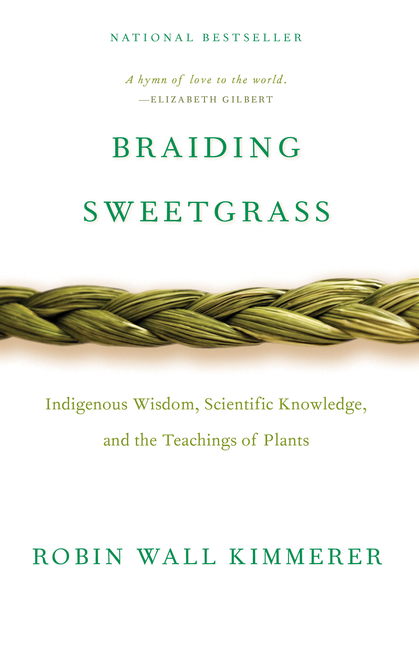
Book Resume
for Braiding Sweetgrass: Indigenous Wisdom, Scientific Knowledge, and the Teachings of Plants by Robin Wall Kimmerer
Professional book information and credentials for Braiding Sweetgrass.
5 Professional Reviews (1 Starred)
Selected for 1 State/Province List
- Publisher's Weekly:
- Ages 12 and up
- TeachingBooks:*
- Grades 7-12
- Cultural Experience:
- American Indian
- Genre:
- Nonfiction
- Year Published:
- 2013
14 Subject Headings
The following 14 subject headings were determined by the U.S. Library of Congress and the Book Industry Study Group (BISAC) to reveal themes from the content of this book (Braiding Sweetgrass).
- NATURE / Essays
- Potawatomi Indians--Biography
- Human-plant relationships
- Philosophy of nature
- Human ecology--Philosophy
- Indian philosophy
- Ethnoecology
- SOCIAL SCIENCE / Ethnic Studies / Native American Studies
- NATURE / Plants / General
- Kimmerer, Robin Wall
- Botany--Philosophy
- Nature--Effect of human beings on
- Potawatomi Indians--Social life and customs
- SCIENCE / Life Sciences / Botany
5 Full Professional Reviews (1 Starred)
The following unabridged reviews are made available under license from their respective rights holders and publishers. Reviews may be used for educational purposes consistent with the fair use doctrine in your jurisdiction, and may not be reproduced or repurposed without permission from the rights holders.
Note: This section may include reviews for related titles (e.g., same author, series, or related edition).
From Publisher's Weekly
Starred review from October 3, 2022
In this young readers adaptation of the 2013 adult bestseller of the same name by Potawatomi botanist Kimmerer, Smith (I Hope), who is Cree and Lakota, breaks down myriad Indigenous nations' relationships with nature. The creators detail how humankind's reciprocity with the earth is integral to many Native peoples' mindsets and often stems from a gifting economy, in which plants and animals make a gift of themselves and humans, in turn, care for them. This is the foundation of the Honorable Harvest, the narrative's key concept and a core Native practice that "governs our taking, shapes our relationships with the natural world, and reins in our tendency to consume." These guidelines also encourage sustainability in hunting and gathering etiquette, and in further developing clean energy procedures. Smith smartly streamlines language while staying true to the narrative's core concepts by adding brief sidebars that explain featured terminology, pose reflection questions, and highlight important passages, inviting collaborative discussion and acting as a call to action. Crisp pen and ink wash illustrations by Navajo artist Neidhardt (When We Are Kind) provide visual interest; by depicting Skywoman's creation in comics spreads, Neidhardt both complements and elevates Smith's approachable prose. Ages 12—up.
From Kirkus
August 15, 2020
Wisdom about the natural world delivered by an able writer who is both Indigenous and an academic scientist. "This braid is woven from three strands," writes Kimmerer, an enrolled member of the Citizen Potawatomi Nation: "indigenous ways of knowing, scientific knowledge, and the story of an Anishinabekwe scientist trying to bring them together in service to what matters most." The author's 2013 book of essays on Native folkways concerning plants and their roles in human life is reissued here with new illustrations and design, a handsome production that well serves her engaging text, which will be of interest to readers schooled in the work of writers such as Wendell Berry, Leslie Marmon Silko, and Joy Harjo. In Anishinaabe belief, writes Kimmerer, sweetgrass "was the very first to grow on the earth," a constant reminder of the creator called Skywoman. It holds a sacred role, and it represents an important component of what the author describes as "global ecosystems," which speak to the possibility of positive interactions between humans and the natural environment, a welcome optimism given all the counterexamples one might produce of our destructive influences. Rethinking that possibility requires going to first principles. As Kimmerer writes, the English word bay is a noun, trapping a natural thing into a static category best reserved for dead things, whereas the Ojibwe word wiikwegamaa, turning the concept into a verb meaning "to be a bay," "releases the water from bondage and lets it live." Indigenous knowledge instructs those who seek healthy relations with their surroundings in many ways. Kimmerer writes of a teacher who directs us to walk in such a way "that each step is a greeting to Mother Earth" while the dread monster called the Windigo speaks metaphorically to our need to consume: "The more a Windigo eats, the more ravenous it becomes." A smart, subtle overlay of different systems of thought that together teach us to be better citizens of Earth.
COPYRIGHT(2020) Kirkus Reviews, ALL RIGHTS RESERVED.
From Publisher's Weekly
August 19, 2013
With deep compassion and graceful prose, botanist and professor of plant ecology Kimmerer (Gathering Moss) encourages readers to consider the ways that our lives and language weave through the natural world. A mesmerizing storyteller, she shares legends from her Potawatomi ancestors to illustrate the culture of gratitude in which we all should live. In such a culture, "Everyone knows that gifts will follow the circle of reciprocity and flow back to you again... The grass in the ring is trodden down in a path from gratitude to reciprocity. We dance in a circle, not in a line." Kimmerer recalls the ways that pecans became a symbol of abundance for her ancestors: "Feeding guests around the big table recalls the trees' welcome to our ancestors when they were lonesome and tired and so far from home." She reminds readers that "we are showered every day with gifts, but they are not meant for us to keep... Our work and our joy is to pass along the gift and to trust that what we put into the universe will always come back."
From Library Journal
August 1, 2013
Kimmerer (environmental & forest biology, State Univ. of New York Coll. of Environmental Science & Forestry, Syracuse) was awarded the 2005 John Burroughs Medal for outstanding nature writing for her first book, Gathering Moss. In these beautifully written essays, she explores the natural world, wedding the scientific method with the traditional knowledge of indigenous people. Kimmerer herself is a member of the Citizen Potawatomi Nation. Bringing together memoir, history, and science, she examines the botanical world, from pecans to sweetgrass to lichens to the three sisters (corn, beans, and squash), also describing moments of her past, such as boiling down maple sap to make syrup with her children. She shares her efforts to reclaim her culture through studying the language and learning to weave baskets. Intertwined throughout is the history of the injustices perpetrated against indigenous people and the land. Kimmerer writes of investigating the natural world with her students and her efforts to protect and restore plants, animals, and land. A trained scientist who never loses sight of her Native heritage, she speaks of approaching nature with gratitude and giving back in return for what we receive. VERDICT Anyone who enjoys reading about natural history, botany, protecting nature, or Native American culture will love this book.--Sue O'Brien, Downers Grove P.L., IL
Copyright 2013 Library Journal, LLC Used with permission.
From Kirkus
Many Native peoples in northern North America use sweetgrass in their traditions and ceremonies, often braided. In this audiobook environmental biologist Robin Wall Kimmerer uses it as a subject and a metaphor. Her own personal braid includes the traditional wisdom of her Potawatomie ancestors and her scientific training. In narrating her own audiobook, she adeptly shares the experience of encountering the natural world through both lenses. Her voice is warm and welcoming, and her discussions of how to live in the world invite us to share her feelings and opinions, rather than trying to sell us on the rightness of her thinking. It's a very effective approach, and an affecting listen. D.M.H.
1 Selection for State & Provincial Recommended Reading Lists
Braiding Sweetgrass was selected by educational and library professionals to be included on the following state/provincial reading lists.
United States Lists (1)
Preview Digital Book
Explore Braiding Sweetgrass on Marketplace. Access requires OverDrive Marketplace login.
This Book Resume for Braiding Sweetgrass is compiled from TeachingBooks, a library of professional resources about children's and young adult books. This page may be shared for educational purposes and must include copyright information. Reviews are made available under license from their respective rights holders and publishers.
*Grade levels are determined by certified librarians utilizing editorial reviews and additional materials. Relevant age ranges vary depending on the learner, the setting, and the intended purpose of a book.
Retrieved from TeachingBooks on October 23, 2026. © 2001-2026 TeachingBooks.net, LLC. All rights reserved by rights holders.
