
In-depth Written Interview
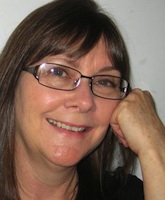
with Jo Ellen Bogart
Insights Beyond the Meet-the-Author Movie
Jo Ellen Bogart and Barbara Reid, interviewed in Toronto, Ontario on August 15, 2011.
— JO ELLEN BOGART, Gifts author —
TEACHINGBOOKS: Why write Gifts? What inspired you to write it?
JO ELLEN BOGART: What inspired Gifts was the kinds of things that I collect and the things that I notice when I travel. I notice people and things.
I collect a lot of souvenirs, but they're not T-shirts or hats or anything like that. I collect little bits of nature: seashells and rocks and driftwood. I started thinking about what sorts of things people bring back when they travel, and I got to thinking about some really unusual but often intangible things that people bring back with them. Then, I got to the point of thinking that people bring back stories.
I also collect songs. I buy CDs of music, and I buy cookbooks and things like that. So thinking of all those things, I wrote a song called Souvenirs. The song eventually evolved into the book, Gifts. Gifts came out of the desire to share when I travel—to come back and bring something meaningful, which is often a story.
TEACHINGBOOKS: Please talk about the song, Souvenirs.
JO ELLEN BOGART: At first, I wrote a song called Souvenirs, and as Souvenirs dug its way into me, I realized that I needed a sympathetic character. To me, that was a grandmother. I was dreaming for years of being a grandmother, and so she was the perfect character for me. Her relationship with the granddaughter was what I wanted to portray.
TEACHINGBOOKS: You like stories about traveling. What is it about traveling that gets your creative juices flowing?
JO ELLEN BOGART: As a young person in my 20's, I made my way around South America. Seeing things that I hadn't grown up with was amazing—different foods and different ways of living. I picked up a lot of cookbooks and Latin American music, and I met a lot of interesting animals. We have different viewpoints when we travel, and we have surprises.
What I like about traveling is that you see that things are different from what you know. You might think that the way you live is the way everybody lives, but it's not true, and you get to see other people living their lives.
TEACHINGBOOKS: Please talk about your book Ten for Dinner.
JO ELLEN BOGART: Ten for Dinner is a math book. My mother was a teacher, and she was very big on math. When I wrote Ten for Dinner, I was actually sitting on my patio on the fifth of May, which is the Mexican holiday, El Cinco de Mayo. I was writing a possum story, but all of a sudden, I got the idea of 10 characters doing different things. I immediately put the possum book down, and I wrote Ten for Dinner right there with my feet up on my patio table on my patio. That was a really, really fun book to write because the characters were zany—especially the one in the little devil suit.
TEACHINGBOOKS: Math is fun for you to write about. Why is that?
JO ELLEN BOGART: Why is math fun? Well, it's challenging, and I have a great respect for it. Math and science are our way of looking at the universe and trying to understand it. Another book that I did that has to do with understanding the universe is Big and Small, Room for All because I think about things that are so huge and so far away that we don't see them or think about them and about things that are so small we don't see them. They're all around us. I wanted children to think of things that exist that they will never actually see with their naked eye.
TEACHINGBOOKS: Were you a writer as a child?
JO ELLEN BOGART: I was not a writer as a child. We lived in the country, and I spent my childhood playing in the mud, riding my bicycle, and playing on my rope swing. Also, I was big sister to three younger siblings, which actually takes more time than you would imagine. I loved looking at the natural world; I had a little hideout in a bush where I liked to think.
TEACHINGBOOKS: What can you share about your childhood as it relates to being a writer now?
JO ELLEN BOGART: As a child, I spent a lot of time on my own, and maybe this made me think about things a little bit more. Living in the country, there weren't other children around to play with, and I didn't go to school until I was about seven years old. I had a make-believe friend, which was very nice for imaginary things. Daniel's Dog is about a child's imaginary dog. I had one named Lucy.
TEACHINGBOOKS: What do you love about writing?
JO ELLEN BOGART: I love writing because it's a way of talking to other people, especially kids. You don't even have to be there when you talk to them because your words are there waiting for them to find.
TEACHINGBOOKS: What do you like to tell students?
JO ELLEN BOGART: I really, really enjoy talking to schoolchildren. They're my favorite audience. I often tell them about the pets that I've had. I had pets during my childhood when there weren't that many people to play with, so they were very dear to me. When I tell them that I'm rather fond of reptiles, I get a huge response—the hands go flying up. I tell them about turtles and snakes that I've had, and then they start telling me about their pets.
I really like fish, too. I have a pond in the backyard, and I have many fish tanks. I tell them about my books, but I also tell them about my life. I also tell them that their lives are full of things that would make good stories. I always tell them to appreciate their own lives and what's happening.
TEACHINGBOOKS: What do the students like to tell you?
JO ELLEN BOGART: When I talk to students in schools, they often respond to what I've told them, so if I have talked about pets, they tell me about their pets. If I talk about my brothers and sisters, they're eager to join in and tell me what their brothers and sisters have done. So we get a lot of stories going back and forth. I really like to hear what kids tell me; I like a long question-and-answer period.
TEACHINGBOOKS: What is something else about your work that you want to share?
JO ELLEN BOGART: Something people might not know about me is that I write song lyrics. Poetry is my favorite form of writing—I like the rhythm and the rhyme. Anyone who writes rhyming poetry with a beat might be writing a song. My lyrics have been put into songs by a musician that I work with, so this is another whole kind of joy I have.
TEACHINGBOOKS: What is interesting to you about Gifts?
JO ELLEN BOGART: I'm so thrilled that our book, Gifts was chosen for the TD Grade One Book Giveaway. Grade one is a very important grade—it is such a year of growing—and the fact that each child in Canada will have in his or her hand our book is amazing and fabulous. Since Gifts is not a brand new book, we're going to be touching a new generation of children. We're going to be having children see this book when maybe their parents even knew it, which is so very thrilling.
TEACHINGBOOKS: What are your beliefs about reading and the importance of books for young people?
JO ELLEN BOGART: I think that books are one of the most important things that children will come across. Those books may be in printed form or something that's being read to them. They may listen to an audio book, or they may see the book animated. All these things are so important because they open the child's mind to new ideas. Books introduce new worlds. Books are indispensible.
— BARBARA REID, Gifts illustrator —
TEACHINGBOOKS: What was challenging for you about illustrating Gifts?
BARBARA REID: Gifts was a challenging manuscript to think about illustrating. When I first read the poem, which was originally a song, there were a lot of verses about traveling. It was visually very exciting, but I wanted it to be linked somehow. Creating the story and the characters—the grandmother and the grandchild, who had no description of them at all—was the challenge. It was a challenge creating the characters and giving the verses some kind of timeline.
TEACHINGBOOKS: If you're working with other writers, such as with Jo Ellen, do you have a conversation with them in terms of what they might have been visualizing?
BARBARA REID: When I work on a manuscript written by another author, it's very exciting for me because as soon as I read a book, I have images in my mind. I love to read those words and sink into the story and imagine those characters. Sometimes, it's a little worrisome in case the author has a different vision than me. But I've been fortunate. It's always worked out.
TEACHINGBOOKS: Please describe some of the decisions you made to make the illustrations for Gifts.
BARBARA REID: In Gifts, each spread has its own country; its own culture. I had to think of a way to get that across quickly in the illustrations. For me, the starting point was color. When you think of Australia, it has a certain palette of colors: they're very warm yellows, and the gum trees are quite ghostly. When I thought of China and the Great Wall of China, it has a completely different feel in terms of color. I was flipping through the newspaper and read that "pink is the beige of India," so I knew my palette for India would have a lot of pink.
TEACHINGBOOKS: Please share what struck you as an illustrator about the opening text of Gifts.
BARBARA REID: The opening page of Gifts introduces readers to the grandmother and granddaughter. It starts, "My grandma went a traveling, said what would you have me bring? Not much, said I, just a piece of the sky and a hundred songs I can sing." This is a really nice way to get to know the relationship between the two people.
For me, the whole book is a puzzle—how do you bring home a piece of the sky? I had the vision of swinging because on a swing you get a piece of the sky—and it's an action that they can do together. Then, I thought about songs and singing, and that is something that we learn from our parents and grandparents, and we pass on. It's a really nice gift. So the illustration came together very naturally showing the singing and the swinging.
TEACHINGBOOKS: Please describe your illustration process.
BARBARA REID: The process for creating a Plasticine illustration for me always starts with drawings. I work out what I'm going to do with sketches. Once I'm happy with that, it becomes a lot more fun. I have a piece of nice, hard illustration board. That's the background. Then I start layering the Plasticine, which is a very soft, oily modeling clay that comes in lots of colors.
The way I build up a picture is a little bit like making a pizza. You start with the crust, then the sauce, then the toppings. For the first layer, I spread the Plasticine to create a background, like a sky or snow. Then I start modeling details and sticking them onto the board. Finally, like toppings, I can add textures and things by scratching the Plasticine. When it's all finished, we photograph the artwork, and that gets printed in the book.
I also like to design where the text goes on the page. I usually get a printout of the approximate size of the text. As an illustrator, IÕm trying to take all the room I possibly can for the art and have to grudgingly give some space to the words. Where the text is placed makes a difference, and I like to control that. I like the readerÕs eye to flow through the page in the right direction and get the text at the right moment.
TEACHINGBOOKS: How did you get into Plasticine?
BARBARA REID: I've been playing with Plasticine for as long as I remember. It was one of my favorite materials. Besides drawing, I played with Plasticine by the hour as a child. I made everything out of Plasticine: I made villages, and I tried to make artificial food to make people try to eat it. It is such a fun medium.
I continued fooling around with Plasticine at college, where I learned to be more professional with illustration styles and things. But I always had Plasticine in the drawer. Through a series of flukes, using it for various projects, it became a really fun medium for working in picture books.
TEACHINGBOOKS: What do children ask you most about your work?
BARBARA REID: One of the questions I get the most in schools, particularly if the kids have had a chance to do some Plasticine artwork, is "Do your thumbs get sore?" The worst part of making a Plasticine picture is the patience-requiring time of spreading the background. It does take a little bit of pressure, and, yes, my thumbs get sore. I actually get calluses, but it's just part of the job.
TEACHINGBOOKS: What do you like to tell students?
BARBARA REID: I like to tell kids how rewarding it's been for me to do something that I love doing—drawing and playing with Plasticine—and have it turn into a career. I like to tell kids to pay attention now to what they love to do. I say that if there's something you love to do, whether it's throwing a ball or reading or singing, you're practicing without even knowing it. I tell them to keep doing it because they never know where it's going to take them.
TEACHINGBOOKS: What do you do when you get stuck?
BARBARA REID: When I get stuck, I just walk away from it. If I have a piece of art that's not working or a story line I'm stuck on, I put it away and don't look at it for a couple of days. Then sometimes if I sneak up on that a few days later, all of a sudden, I'm really clear on what's wrong with it and what needs to be changed.
Also, if I've taken a few days away from the problem, I can be a little bit tougher about letting something go that isn't working. Sometimes, it's hard to cross out a beautiful word or take off a pair of beautiful Plasticine eyes that just aren't quite right. But if I've had a few days away from it, I can be much tougher and do it right the next time.
TEACHINGBOOKS: How does it feel to have your book be the TD Grade One Book Giveaway of the year?
BARBARA REID: What's very exciting to me about Gifts being the TD Grade One Book Giveaway is that it's a book about giving. It's really about giving the world. The relationship between the grandmother and granddaughter is such a loving one, and they encourage each other. I think it is like the relationship children have with books. Books can be their first introduction to the whole world. It's a really cheap way to travel. It just whets their appetite for the world.
TEACHINGBOOKS: Please talk about your book The Subway Mouse.
BARBARA REID: I had a lot of fun creating The Subway Mouse. I think of it as a true story because I live in downtown Toronto, and I ride the subway. I'm always looking for nature, and you can find it even underground in the subway. I've noticed that there are mice that live there, and I thought it was a terrible environment for them—noisy and dirty with really terrible food.
I wanted to imagine getting a mouse out of the subway, so I had a wonderful time creating the story of Nib finding his way to the end of the tunnel and coming out on a beautiful starry night. It was fun to create the art using Plasticine and incorporating other materials to get the feeling of the grit of the subway and the litter and the candy wrappers. It was a really fun project.
TEACHINGBOOKS: How did you come to create Perfect Snow?
BARBARA REID: The book Perfect Snow was inspired by eavesdropping on our daughters when I was in the car with them. One of them was recalling a snow fort that her older sister had made many years ago. I thought, "That's a legendary fort," and it piqued my interest. I can remember some legendary days as a child, and I know about all the tensions in the schoolyards about forts being created and wrecked, and I wanted to play with that. I picked a dreamy artistic character who is a creator, and a kind of a bruiser who is probably a fort smasher. It was terrific fun, and I used probably 35 pounds of white Plasticine to create the book.
TEACHINGBOOKS: What are your beliefs about reading and the importance of books for young people?
BARBARA REID: I think that books and stories and artwork are hugely important to children. I heard a wonderful analogy from someone at the International Board on Books for Young People. They said, "Books are windows and mirrors." I just love that because a book is a window that opens the world for a child, but it's also a mirror, where they can find themselves and put themselves into a story.
A book for a young child can be one of their first experiences at imagining the world through someone else's eyes. When they read a book, they can become a mouse. They can be someone that lived 100 years ago. They can become someone in the future or living in another country. I think those experiences and imaginings are very important for young children, and it fosters a sense of the world right from a young age. I think that's very important for every generation.
This In-depth Written Interview was created by TeachingBooks.net for educational purposes and may be copied and distributed solely for these purposes for no charge as long as the copyright information remains on all copies.
Questions regarding this program should be directed to info@teachingbooks.net
